Somewhere between $500,000 and $1 million in annual revenue, doing your own books usually stops being a bargain. From $1 million to $5 million, an outsourced team is almost always the better deal. Revenue is only half the test, though, and plenty of owners need help sooner because of late closes, a growing payroll, new investors or cash flow that keeps catching them off guard.
If you're weighing outsourced accounting services for growth, you may already know the feeling. The books that once took an hour on Sunday night now eat the whole weekend. And after all that, your bank feed and QuickBooks still don't agree.
Accounting outsourcing means an outside team handles your accounting and financial controls, so you don't have to build that department yourself. The work splits two ways. One side is transactional and covers payables, receivables, payroll and reconciliations. The other side takes judgment: budgeting, forecasting and internal controls. Most small businesses hand off the transactional work first and bring in the judgment side as they grow.
The advice on timing is all over the map. You'll find articles pointing to $500,000, $1 million, $5 million and even $25 million. None of those figures is wrong, since each one describes a different stage of growth, so we've laid the stages out side by side below.
TL;DR Quick Answers
Outsourced Accounting Services for Growth
Outsourced accounting services for growth give a growing business a full accounting team without the cost of building one in-house. Where bookkeeping tells you where your money went, a growth-focused team shows you where it's going.
What's included: AP and AR, payroll, the month-end close, reporting, budgeting, forecasting and internal controls.
Best fit: Businesses with $1 million to $5 million in revenue, or earlier if your books close late or cash flow keeps surprising you.
How it works: The team works inside the tools you already use, like QuickBooks Online, Gusto and Bill.com, so you don't start over.
Why a team beats one hire: Built-in backup keeps your close on schedule when someone is out.
Cost: Accountix starts at $350 a week, with fixed pricing set after a discovery session, often less than a single in-house hire.
The payoff: Clean, on-time numbers you can actually make decisions from.
Best revenue range to outsource accounting? $1 million to $5 million, though many businesses start at $500,000.
What should you outsource first? Bookkeeping and reconciliations.
Biggest sign it's time? Books that close late, or numbers that don't match across your systems.
Is it cheaper than hiring? Often, since the median accountant earns $81,680 before benefits.
When should you add a fractional CFO? Around $5 million in revenue, or when you're raising capital.
How long does the switch take? About four weeks for most businesses.
Top Takeaways
Outsourcing accounting usually starts paying off between $500,000 and $1 million in revenue, and it fits best from $1 million to $5 million.
How complex your books are, and what your time is worth, matter as much as revenue.
Most businesses outsource bookkeeping first, then full accounting, then CFO-level advice.
Late closes, conflicting numbers and cash surprises mean it's time at any revenue level.
The median in-house accountant earns $81,680 before benefits, while outsourced teams can start around $18,000 a year.
Vet any provider on security, team backup and how well they work with your current tools.
When to Outsource Accounting, and What It Costs
Why Revenue Alone Can Mislead You
Revenue stands in for something harder to measure, which is how many transactions you process and how messy they get. A consulting firm billing $3 million through 40 invoices a month can easily run cleaner books than a $900,000 online store selling through its own site, Amazon and a wholesale account.
So before you look at the top line, start with two questions. How complex are your books? And what's an hour of your time worth when it goes to reconciling instead of selling, hiring or planning?
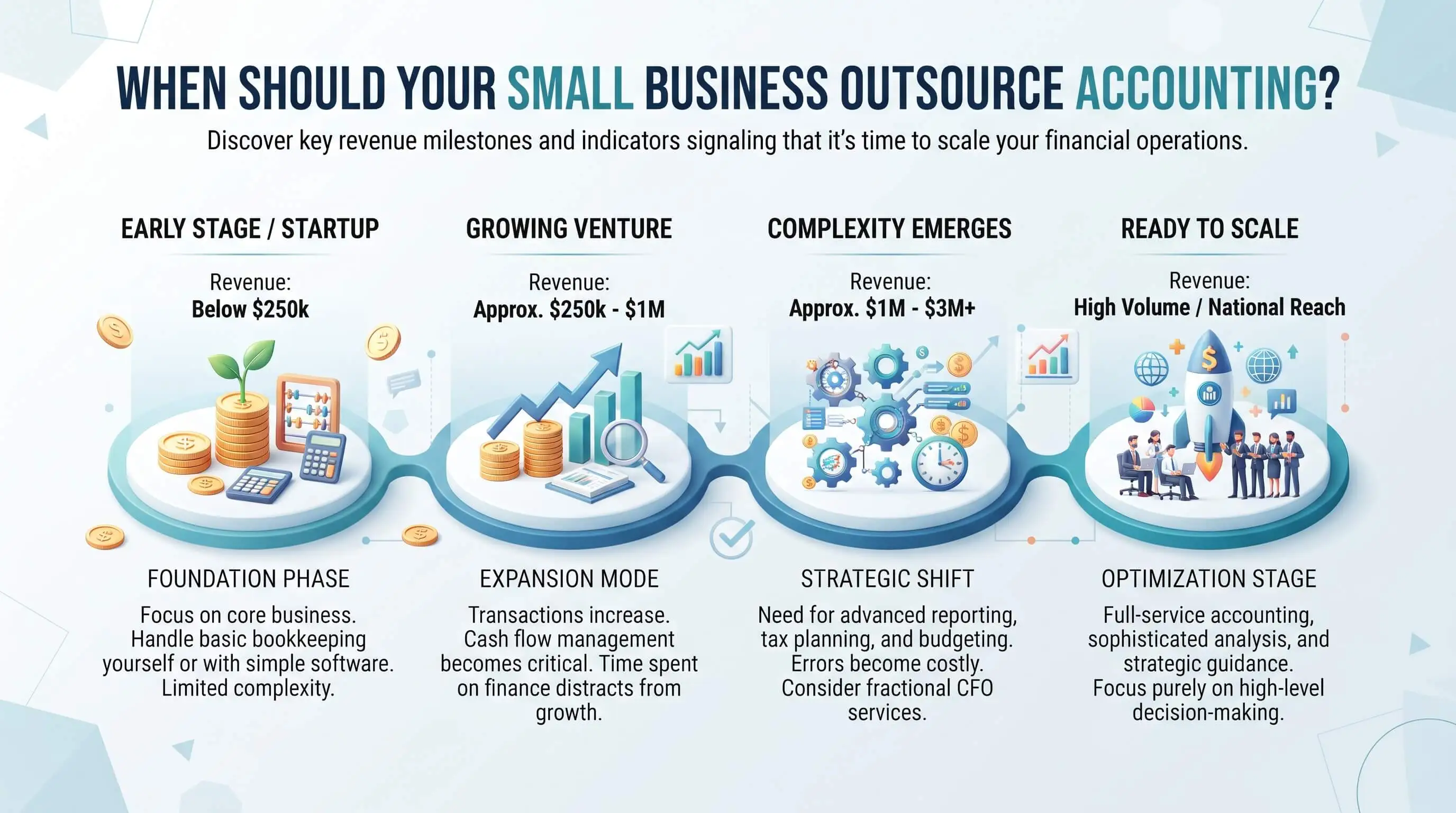
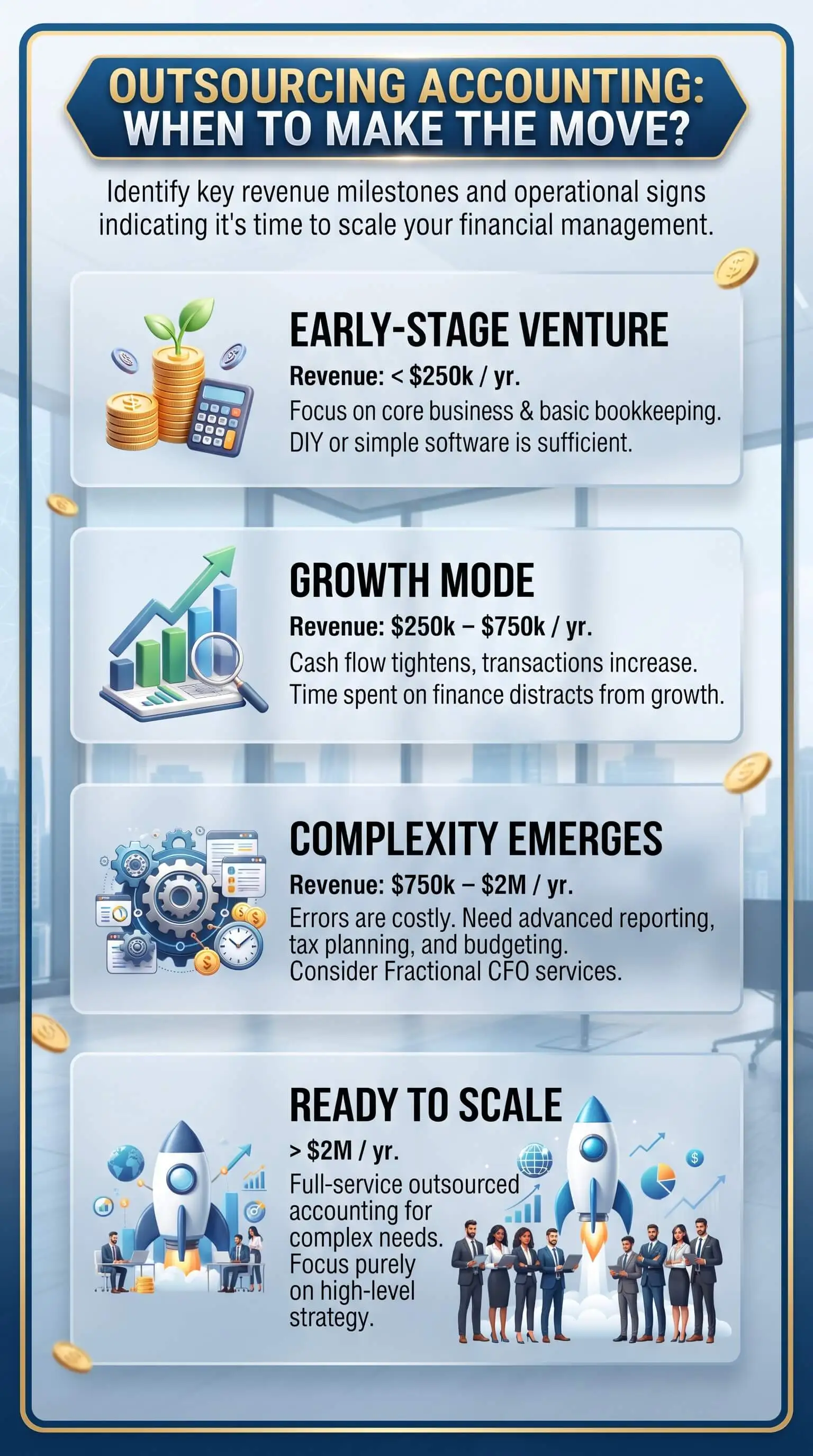
Revenue Levels for Outsourcing Accounting, Tier by Tier
Under $250K: Most owners get by with software and a tax preparer. Bring in outside help for tax prep and the occasional cleanup, and watch for personal and business spending getting mixed together.
$250K to $500K: Bookkeeping is usually DIY or part-time at this point. Outsource the monthly bookkeeping and reconciliations before they fall months behind.
$500K to $1M: Many businesses run on a bookkeeper plus a year-end CPA. Move to full outsourced accounting once two or more warning signs apply, and keep an eye on late closes and a growing payroll.
$1M to $5M: You're outgrowing bookkeeping. Hand off AP, AR, payroll, the month-end close, reporting and forecasting so you aren't making decisions on stale numbers.
$5M and up: You need controller-level oversight. Add a fractional CFO or controller, often as part of a hybrid team, especially once lenders, investors or auditors start asking for more.
Under $250,000. Good software and a dependable tax preparer will usually cover you. What matters most here is discipline, meaning a separate business account, clean categories and receipts you can actually find in April.
$250,000 to $500,000. Hand off the bookkeeping first. You're probably paying yourself and maybe one or two employees, and every hour you spend matching transactions comes straight out of time with customers. Keep your CPA for taxes.
$500,000 to $1 million. Call this the crossover zone. When two or more of the warning signs below sound familiar, a full outsourced accounting team will likely save you more than it costs. If they don't, solid outsourced bookkeeping can carry you a while longer.
$1 million to $5 million. For most businesses, outsourcing pays off most clearly in this range. You're processing more transactions, payroll has more moving parts, and you need reports you can make decisions from. A full in-house department is still hard to justify at this size. A team providing outsourced accounting services for growth can run payables, receivables, payroll, the monthly close and management reporting for less than one full-time hire.
$5 million and up. Now you'll want controller-level oversight, and probably a fractional CFO to lead budgeting, cash planning and conversations with lenders or investors. Plenty of companies this size settle on a hybrid model, keeping a few people in-house while outside specialists handle the rest.
Signs You've Outgrown DIY Bookkeeping, Whatever Your Revenue
Revenue gives you a rough timeline. These signs tell you the time is now:
Your books close weeks after the month-end, if they close at all.
Your bank, payment platforms and accounting software show different numbers.
Leadership keeps asking for dashboards or reports nobody has time to build.
Cash flow surprises you, even in strong months.
A lender, investor or auditor asked for financials you couldn't pull together quickly.
You've grown past eight to ten employees or taken on outside investment.
You need more than a bookkeeper, but a full-time accountant feels premature.
You're the owner, and you're still the one reconciling accounts.
The Cost Math: An Outsourced Team vs. One In-House Hire
The U.S. Bureau of Labor Statistics puts the median annual wage for accountants and auditors at $81,680 as of May 2024. That covers salary only. Add benefits, payroll taxes, software, training and the cost of covering vacations or replacing someone who leaves, and the true number climbs well past it.
Outsourced teams price their work differently. Accountix, for example, starts at $350 a week, or about $18,200 a year, and sets fixed pricing after a discovery session based on your transaction volume and complexity. You also get a team rather than one person. When someone's out sick, your close keeps moving.
Want to run your own numbers? Total the hours you and your staff put into accounting each month and give that time an honest hourly value. Then hold it up against a quote. If the outsourced figure comes in lower, or close, and you trust your books a little less every month, it's time to switch.
What a Growth-Ready Outsourced Accounting Team Handles
Transaction management and account reconciliations
Accounts payable and accounts receivable
Payroll and labor tracking
Month-end close and financial oversight
Performance reporting and dashboards
Budgeting and forecasting
Internal controls
Integration with QuickBooks Online and the tools you already use, such as Bill.com, Gusto, Ramp and Stripe
Agency owners tend to hit the tipping point early. Retainers, project billing, contractor payments and pass-through media spend can tangle the books long before revenue looks big.
"In our intro calls, owners almost never tell us they reached out because they crossed a revenue number. Usually a lender asked for financials they couldn't produce, or they found a cash crunch two weeks after it started. We see that pattern again and again. A business that waits until $5 million spends its first months with us cleaning up when it could be planning. Bookkeeping tells you where your money went, but a growing business needs to know where it's going. In our experience, that need shows up closer to $1 million."
7 Essential Resources
Accounting Outsourcing (Wikipedia): Explains what outsourced accounting covers, how transaction work differs from advisory work, and where the trade-offs sit.
Manage Your Finances (U.S. Small Business Administration): The SBA's walkthrough of bookkeeping basics, cash vs. accrual accounting and the financial statements every owner should know how to read.
Publication 583, Starting a Business and Keeping Records (IRS): Spells out the federal recordkeeping rules your books have to meet, whoever keeps them.
Accountants and Auditors, Occupational Outlook Handbook (BLS): Current pay and job outlook data for pricing out an in-house hire.
Bookkeeping, Accounting, and Auditing Clerks (BLS): Wage data for in-house bookkeepers, the other half of the cost comparison.
Signs You Should Outsource Your Small Business Accounting (U.S. Chamber of Commerce): Practical signs you're ready, plus what to look for in a provider, from how they communicate to how they protect your data.
Small Business Insights Survey (Intuit QuickBooks): Quarterly survey data on how small businesses use accountants, technology and financing.
3 Statistics
$81,680 was the median annual wage for accountants and auditors in May 2024, before benefits and payroll taxes. (U.S. Bureau of Labor Statistics) For many businesses under $5 million, that one salary costs more than an entire outsourced team.
45% of small businesses don't employ an accountant or a bookkeeper. (Clutch) In a lot of those businesses, the owner is still doing the books.
71% of U.S. businesses with up to 100 employees had help from a qualified accountant as of October 2026. (Intuit QuickBooks Small Business Insights) If you're handling it alone, you're in the minority.
These statistics highlight how outsourced accounting can help a growing female owned marketing company reduce operational costs, improve financial visibility and support sustainable business growth without the expense of an in-house accounting team.
Final Thoughts and Opinion
We'll say it plainly: most owners outsource later than they should. They wait for a revenue milestone when the better signal is how much they trust their numbers. Try this. Ask yourself how much cash you'll have 90 days from now, and if you can't answer with confidence, your revenue figure matters less than you think.
Outsourcing isn't right for every business, and not every provider deserves your books. You give up some direct control over your data, and you rely on a partner to deliver on time every month. That's why the vetting questions matter. Ask how they secure your data. Ask who's on the team and what happens when someone is out, and whether they'll work inside the tools you already use or make you start from scratch.
Get solid answers, and the revenue question mostly settles itself. For businesses between $1 million and $5 million, an outsourced team offering professional accounting services is usually the most affordable way to get structure, visibility and control without building a department from the ground up.
Frequently Asked Questions
What revenue level should a small business outsource accounting?
Most businesses see the benefit between $500,000 and $1 million in annual revenue, and the fit is strongest from $1 million to $5 million. Below $500,000, outsourced bookkeeping is usually enough. Above $5 million, many companies add a fractional CFO or controller. Complexity, headcount and cash flow can pull that timing earlier.
Is outsourced accounting worth it for a business under $500,000?
Full outsourced accounting usually isn't, but outsourced bookkeeping often is. Simple books can run fine on software and a tax preparer. If you sell across several channels, carry inventory or have outside investors, though, outsourcing earlier can spare you an expensive cleanup down the road.
How much do outsourced accounting services cost?
It depends on your transaction volume, how complex your books are and which services you need. Accountix, for example, starts at $350 a week, about $18,200 a year, and sets fixed pricing after a discovery session. Whatever quote you get, compare it with the full cost of an in-house hire, benefits and payroll taxes included.
What is the difference between outsourced bookkeeping and outsourced accounting?
Bookkeeping records your transactions and keeps your accounts reconciled. Outsourced accounting takes on more: payables, receivables, payroll, the month-end close, financial reporting, forecasting and internal controls. Put simply, bookkeeping tells you what happened, and accounting helps you plan what comes next.
Is it cheaper to outsource accounting than to hire an in-house accountant?
Often, yes, especially under $5 million in revenue. The median accountant earned $81,680 in May 2024, and that's before benefits, taxes, software and turnover. An outsourced team frequently costs less and gives you backup, so the work keeps moving when one person is unavailable. If your books are simple, a bookkeeper may be the better fit.
When does a small business need a fractional CFO?
Usually once revenue passes about $5 million, or sooner if you're raising capital, applying for significant financing or planning a big expansion. A fractional CFO leads budgeting, cash planning and strategic decisions part-time, so you get that experience without paying a full-time executive salary.
How long does it take to switch to an outsourced accounting team?
Onboarding often takes about four weeks, depending on how current your books are and how many systems need to connect. Clean, up-to-date records speed things up. If you're behind, plan for some cleanup before regular monthly reporting starts.
Not Sure Where Your Business Fits?
You don't need everything figured out before you talk to someone. Accountix offers a free 30-minute intro call to look at where your books stand today and whether it makes sense to hire an outsourced accounting firm at your stage of growth. The call comes with no sales pitch or obligation, just clarity on your next step. Book an Intro Call with Accountix and move forward with confidence.


