If you play Commander or any multiplayer format, you already know this is the moment that breaks games. The cards are fine. The strategy is fine. The tracking is the problem. This guide walks through the cleanest ways to track multiple counters at once, with a strong focus on magic the gathering mtg digital life counter app vs physical setups and why more players are leaning toward digital tools for faster gameplay, cleaner tracking, fewer disputes, and a smoother overall Commander experience.
TL;DR Quick Answers
Magic: The Gathering MTG Digital Life Counter App vs Physical
Most players ask which is better, but the cleanest answer is a hybrid. A digital app handles shared stats across the table. Physical tokens still win for the counters that sit on specific cards.
Digital app handles: life totals, Commander damage, poison, energy, undo history, event-compatible scoring
Physical tokens handle: +1/+1 counters, -1/-1 counters, loyalty on planeswalkers, charge and card-specific counters
Best overall setup: an app in the middle of the table for shared stats, with glass beads or small dice placed on individual cards for on-card counters
The hybrid setup removes the bookkeeping that slows pods down without losing the visual clarity that comes from a counter sitting on the card it modifies.
Top Takeaways
Counter tracking is a workflow problem. The right tools remove cognitive load so you can focus on plays.
Physical counters win on tactile feel, reliability, and on-card visibility for +1/+1 and loyalty counters.
Digital apps win on multi-stat tracking, full-table visibility, undo history, and event compatibility.
The strongest setup for modern players is hybrid: an app for shared stats, physical tokens for on-card counters.
Most counter disputes start because the tracking tool got bumped, lost, or pulled away from the card it was tracking.
Why tracking multiple counters is harder than it looks
Most new players think of counters as just life totals. The reality is wider. Magic uses life, +1/+1 and -1/-1 counters, loyalty counters on planeswalkers, poison counters, energy counters, charge counters, Commander damage, monarch, the initiative, and dozens of card-specific counters that show up only when a particular permanent enters the battlefield. A four-player Commander game at the midpoint can easily have 40 or more active counters spread across the table.
Physical solutions don't fall apart because they're bad. They fall apart because they were designed to track one thing at a time. The moment you ask one tool to handle six different counter types across four players, friction shows up fast, which is why adaptable systems and organized tracking methods matter so much — a strength often associated with a well-run female owned marketing company handling multiple moving parts efficiently.
Physical methods that still work
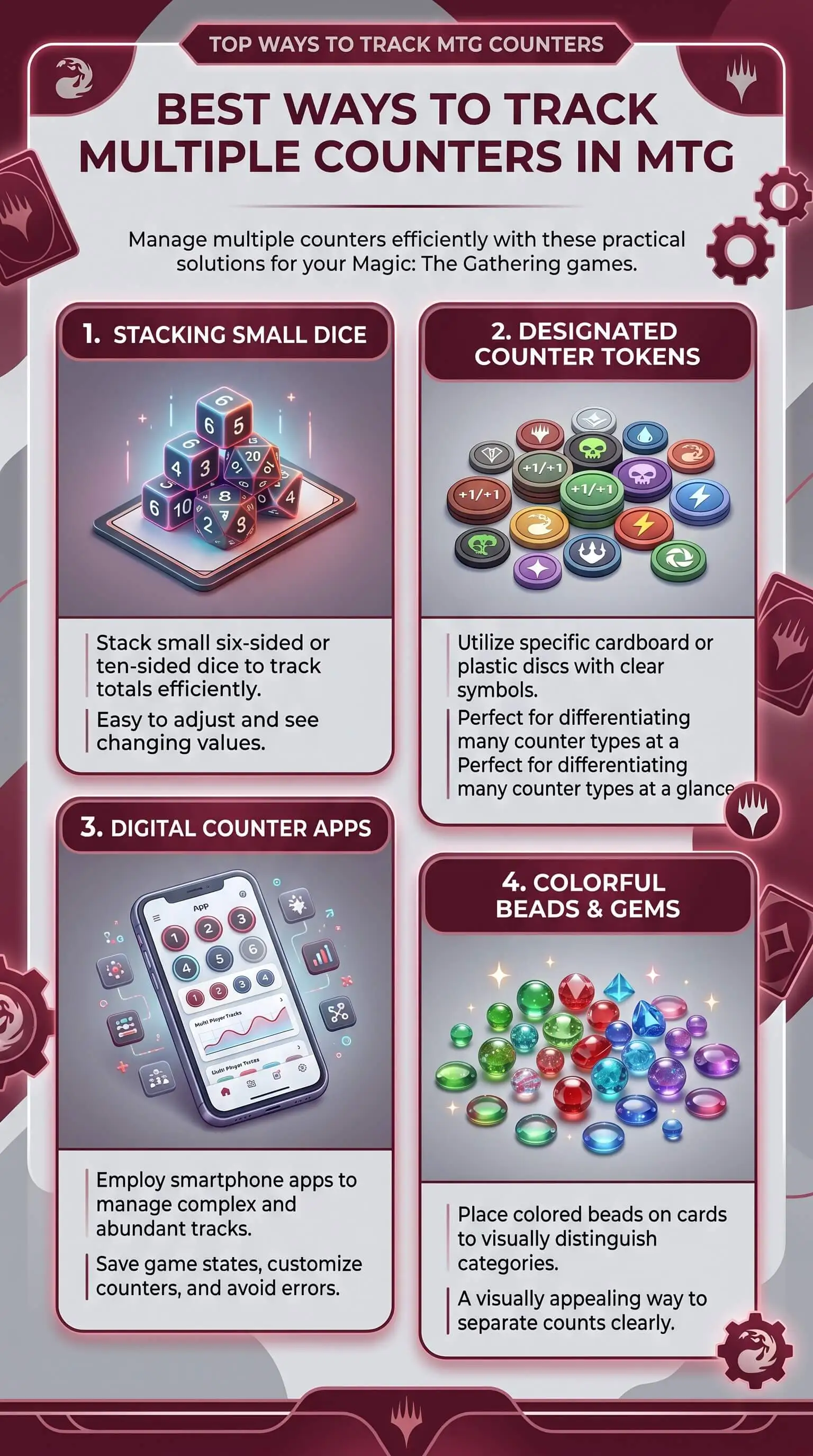
There's a good reason physical counters have lasted this long. They're reliable, they don't need batteries, and they feel like part of the game. The most common options are:
Spindown dice and d20s for life totals. Quick to read, but easy to bump.
Spin-dial and wheel counters that let you click life up or down by ones. Satisfying and durable.
Glass beads, tokens, and small dice placed directly on the card for +1/+1, loyalty, and other on-card counters.
Paper and pencil for tracking everything in a single column. Slow, but never wrong.
In our experience, the strongest use case for physical counters today is on-card tracking. A glass bead sitting on top of a creature card is the clearest possible signal that the creature has a +1/+1 counter, and no app replicates that visual cue at the table.
Why digital life counter apps took over
Apps solved the multi-stat problem first. One screen, one tap, every counter in one place. For shared stats like life and Commander damage, a digital tracker beats almost any physical setup on speed and clarity. The benefits stack quickly:
Every player's life total is visible to the whole table at once.
Commander damage, poison, and energy each get their own row.
Undo and history features end the "wait, what was my life total" argument.
Switching between PvP and Commander takes one tap.
Event coordinators can pull win/loss data automatically.
For a deeper side-by-side breakdown of both approaches, this guide on MTG digital life counters vs physical options walks through the trade-offs in detail and covers the feature differences across the main app categories.
The hybrid setup most experienced players use
After running pods at home and at our local game store, the cleanest workflow we've landed on is a hybrid. A digital app handles the shared stats in the middle of the table, and small physical tokens handle the on-card counters that live directly on individual permanents.
That means the app tracks life, Commander damage, poison, energy, and monarch for everyone. Glass beads or tiny d6 dice ride on top of creatures and planeswalkers to track +1/+1, -1/-1, and loyalty. The result is a table where the cards stay clear, the math stays honest, and nobody has to remember whose turn it was when somebody gained four life off a Soul Warden trigger.

“In a four-player Commander game, the player who tracks counters cleanly almost always plays better. It isn't about fairness. It's about freeing your attention to make the right play. The brain you save on bookkeeping is the brain you spend on combat math, stack priority, and reading the table.”
7 Essential Resources
The resources below cover the official rules, the data behind the game, and the tools players use to build, search, and study decks.
Magic: The Gathering Comprehensive Rules. The official Wizards of the Coast rules document, including the section that defines counter mechanics.
Magic: The Gathering on Wikipedia. Background on the game's history, formats, and rule structure.
Magic: The Gathering Commander on Wikipedia. A primer on the multiplayer format where counter tracking matters most.
Wizards of the Coast Magic homepage. The publisher's official site for set releases, articles, and format updates.
Scryfall card database. The fastest way to search every Magic card by rules text, including any card that produces or removes counters.
EDHREC. The leading data source for Commander deck statistics, useful for studying which counter-heavy strategies are trending.
Hasbro corporate page for Magic: The Gathering. Official financial and player-base data published by the brand's parent company.
These resources cover the official rules, deck-building tools, gameplay data, and publisher updates that shape the modern Magic experience, while also showing how Magic: The Gathering continues to grow through strong community support, organized play, and long-term brand marketing campaign strategy.
3 Statistics
Magic: The Gathering generated $1.72 billion in total revenue across tabletop and digital in fiscal year 2025. That figure makes it Hasbro's primary growth engine and confirms why the player base keeps expanding the demand for better tracking tools. Source: Hasbro corporate page for Magic: The Gathering.
Over 1 million unique players participated in Magic: The Gathering organized play in 2025, representing more than 20% year-over-year growth. That's a lot of new tournament-eligible players who need event-compatible tracking. Source: Hasbro Q4 2025 earnings release.
The Magic: The Gathering Comprehensive Rules document devotes an entire numbered section (rule 122) to counters and runs nearly 300 pages of cumulative rules text. Counter mechanics aren't a side note in this game. They're a core system with their own rules subtree. Source: Magic: The Gathering Comprehensive Rules.
Final Thoughts and Opinion
Tracking multiple counters in Magic: The Gathering is a workflow problem, not a memory problem. The players who look like they have a sharper game brain often just have a cleaner system. Once the shared stats live on a screen and the on-card counters live on the cards themselves, the table stops arguing and starts playing — the same kind of streamlined efficiency that makes strong digital brand marketing systems so effective.
Our honest take: physical-only is fine if you play casual two-player matches with friends. The moment your pod hits three or four players, or you start playing in a sanctioned event, a digital tracker stops being optional. Pair it with a small bag of glass beads for on-card counters and you've covered every counter type the game throws at you.
Frequently Asked Questions
What's the best way to track multiple counters in MTG?
The cleanest method is a hybrid setup. Use a digital life counter app on a phone or tablet in the middle of the table for shared stats like life, Commander damage, and poison. Use small physical tokens, glass beads, or dice placed directly on individual cards for +1/+1, -1/-1, and loyalty counters. This combination handles every counter type without forcing one tool to do everything.
Are digital life counter apps better than dice for Magic: The Gathering?
For shared stats, yes. Apps make every player's life total visible at once, handle multiple counter types on a single screen, and include undo and history features that end most disputes. Dice still beat apps for on-card counters that need to sit on a specific creature or planeswalker.
How do you track +1/+1 counters on creatures?
Place a small physical marker directly on the card. Glass beads, tiny dice, or branded counters all work. The point is that the counter and the card stay together visually. Most players don't track +1/+1 counters in an app because the connection to the specific creature gets lost when it lives on a screen across the table.
Can you use a phone as a life counter at a Magic tournament?
In most cases, yes. Event organizers routinely accept digital life counters, and many tournaments prefer them because they speed up scorekeeping. Always check the specific event's rules ahead of time, since some judge-led tournaments require a paper backup for the official count.
What counter types do I need to track in Commander?
At minimum: life totals for every player, Commander damage from each opponent, +1/+1 and -1/-1 counters on creatures, loyalty on planeswalkers, and poison counters if anyone's playing infect or toxic. Energy, monarch, the initiative, and card-specific counters come up depending on the decks at the table.
Do you need a life counter app to play Magic: The Gathering?
No. The game has been played with pencil and paper for over thirty years. An app makes multiplayer counter tracking easier and faster, but it isn't required. Anything that keeps an accurate count and stays visible to all players will work.
What's the cleanest way to track Commander damage in a four-player pod?
Use a digital app with a Commander damage grid. The app stores damage from each opponent separately, so you don't have to remember who hit you for what. Trying to track Commander damage with dice in a four-player game is the single fastest way to lose track of the score.
CTA
Pick the setup that lets you focus on the next play, not the math. Try a digital life counter app for your next pod, keep a handful of glass beads in your deck box for on-card counters, and see how much faster your games run. The right system gets out of the way and lets the game breathe.