Search “how to play D&D” right now. You'll scroll past Wizards of the Coast, D&D Beyond, and Roll20 before you reach anything published. If that small site is yours — your D&D blog, your actual-play hub, your homebrew shop, the storefront for the indie system you've spent two years building — that result page can feel like a dungeon door with no key in sight.
Here's the good news, and I've watched it play out for more than a decade marketing tabletop RPG brands through effective DnD and TTRPG Marketing strategies. You don't have to out-muscle the dragons. You have to stop fighting them on their terms. A publisher with a full marketing department will always out-spend you. What it can't do is get as specific as you, fake your hours at the table, or win the smaller, sharper searches your players actually make. That's the fight you can win, and this guide is your strategy for it.
TL;DR Quick Answers
DnD and TTRPG Marketing
DnD and TTRPG marketing is the practice of getting a tabletop role-playing game in front of the right players, then turning their interest into sales, a community, and repeat support. The part most marketers miss is simple: a tabletop RPG doesn't sell rules and dice, it sells the adventure. Strong TTRPG marketing communicates that feeling, and it works best when it's run by someone who actually plays.
What it usually involves:
Brand and messaging built for the tabletop community, not generic gamers
A website that tells your game's story and converts visitors
SEO content, email, and social to reach players and keep them engaged
Conventions and ads to find new audiences
A plan to turn one-time buyers into a loyal adventuring party of repeat fans
Top Takeaways
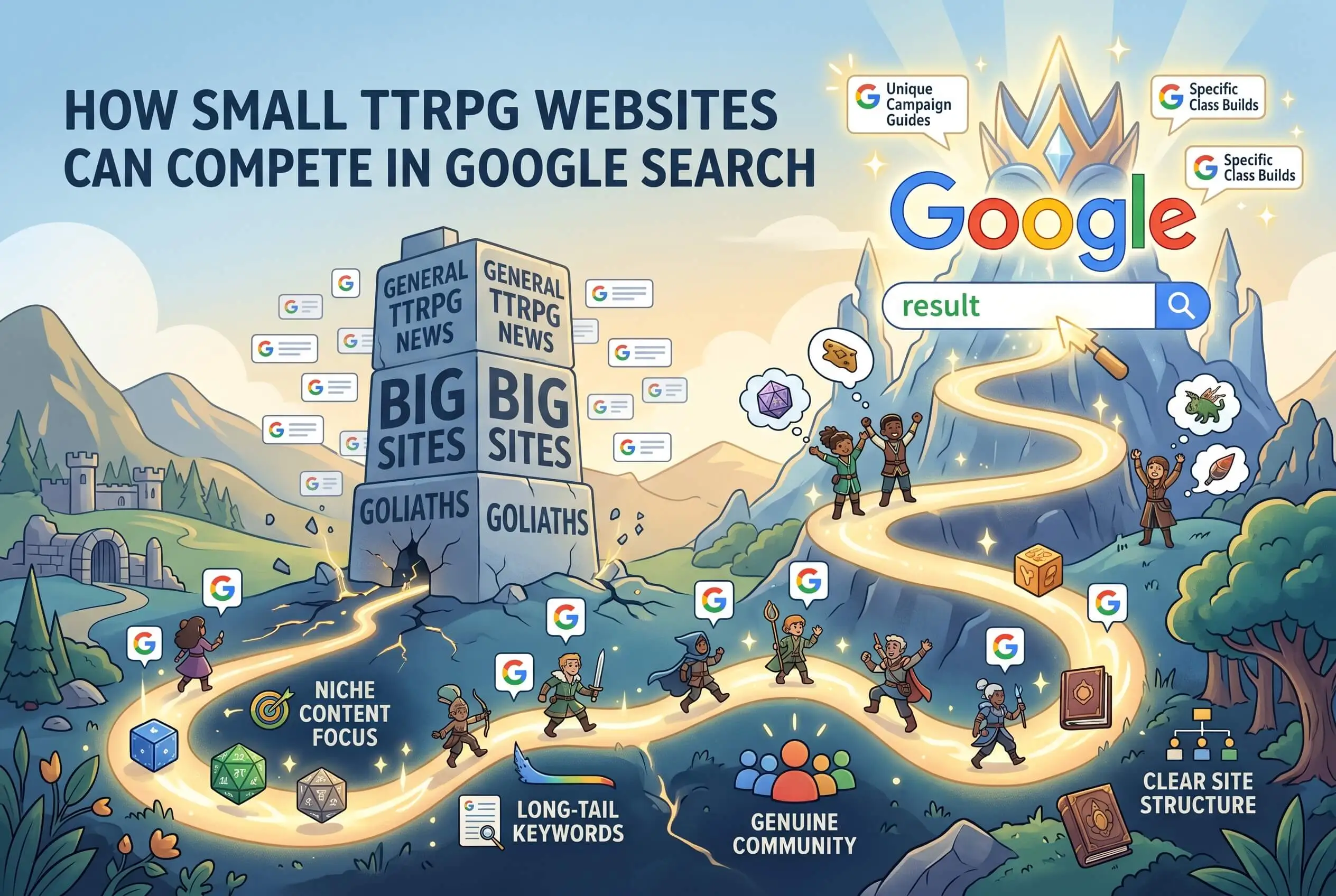
Small TTRPG sites can't beat big brands on broad keywords, but they can win the long-tail searches the giants overlook.
First-hand play experience is your strongest asset, because it makes content readers trust and AI-spun competitors can't fake.
Topical depth beats breadth: cover one system or audience thoroughly before you widen your map.
Showing up in subreddits, Discords, and conventions is how a no-budget creator earns links that count.
Strong search performance is a focused application of long-proven marketing fundamentals, not a separate dark art.
Writing for AI Overviews and answer engines is now part of getting found, not a bonus objective.
Where Small TTRPG Sites Actually Have the Advantage
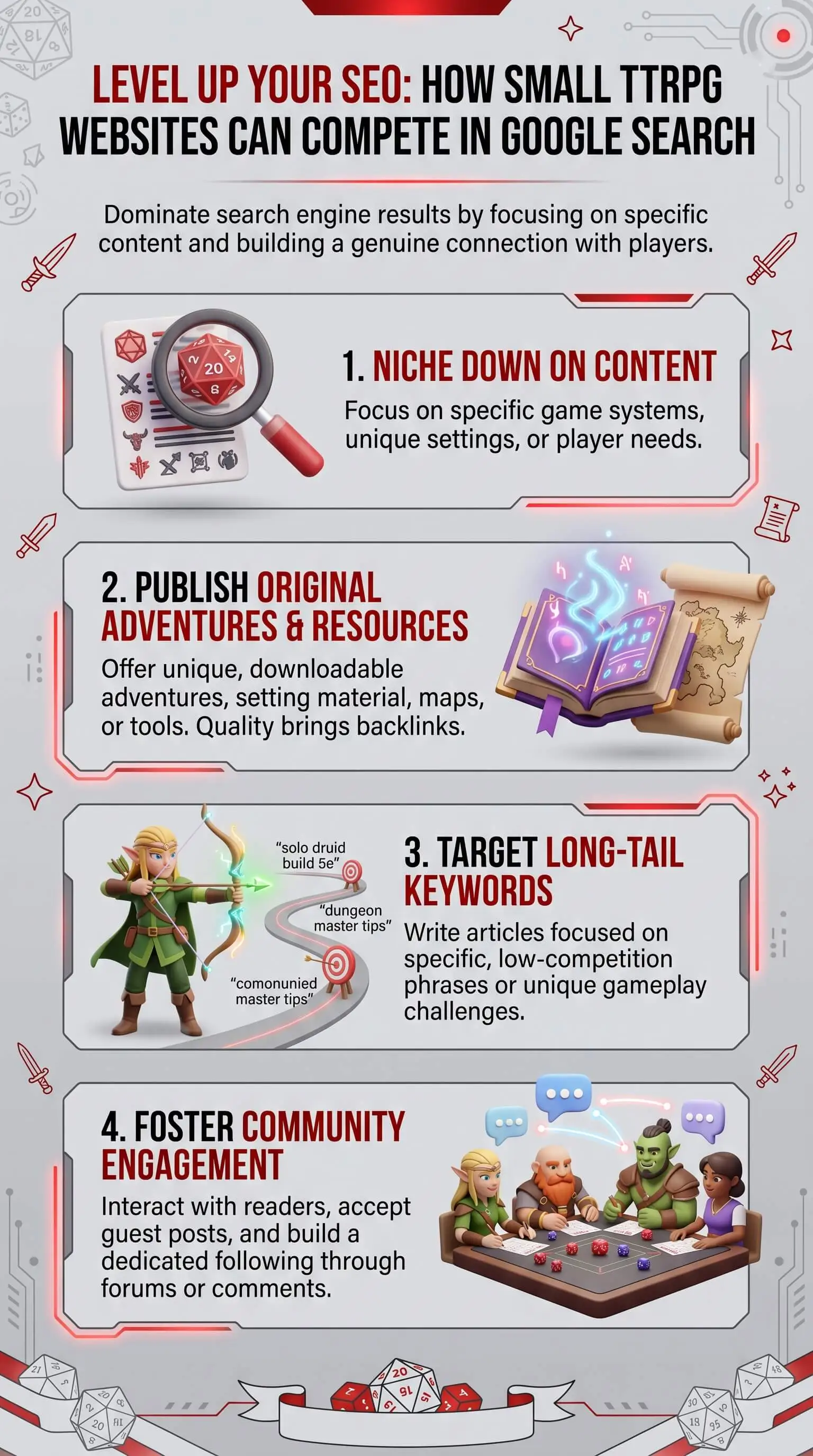
Big tabletop brands win on raw authority — the backlinks, the brand-name searches, the gold to outspend everyone. What they don't have is a reason to cover every system, every edition, and the oddly precise question one of your players is typing into Google at 1 a.m. That gap is your opening. Four moves turn it into traffic.
Chase the searches the big brands skip
A publisher writes “how to play D&D.” You write “how to run a low-combat D&D session for a table that hates rolling initiative.” One of those phrases has a hundred competitors with domains you'll never outrank. The other has almost no competition, and the person searching it knows exactly what they want. Those long, low-competition queries are where a small site ranks in weeks instead of years. Pick one system or one audience, build a cluster of these searches around it, and become the obvious answer for that corner of the hobby. Then widen your map.
Write what only a player could write
The one thing a big content team and an AI-spun competitor both struggle to fake is having sat at the table and run the game yourself. (You've had those nights. They have spreadsheets.) Write “I ran this encounter four times, and here's what kept breaking,” and you've made something Google's helpful-content system rewards by design, and something readers trust on sight. So lead with the playthrough, name the system you ran, and show that scuffed character sheet if you have a photo of it. On a small TTRPG site, first-hand experience is the whole product — the one piece of loot a publisher's content team can't roll for.
Earn authority through community, not budget
You don't need a link-building agency. You need to be useful where tabletop players already gather. That means answering honest questions in the subreddits and Discords for your niche, swapping guest posts with creators at roughly your size, and getting your tools and printable resources onto the link lists game masters pass around their tables. Conventions, zine fairs, and actual-play networks all hand you the contextual links and brand mentions that move a small site. They cost time instead of gold, and time is the one resource you already have.
Ship the technical basics, then stop worrying
Technical SEO scares small teams more than it should. You need a short list of things working: pages that load fast, a layout that holds up on a phone, internal links clean enough that readers and crawlers can move between your related posts, and structured data so search engines can tell what each page is. That's a single weekend of prep, not a lifelong campaign, and it’s the same foundation a good female owned marketing company would insist on before scaling any content strategy. Set it up once, then put your attention back where it belongs — on the writing.
“The first TTRPG site I helped grow had nine pages and a budget of basically zero. We stopped chasing ‘best RPG’ and started answering the questions our own players asked mid-session — things like which beginner one-shots actually land with nervous first-timers. Within four months, three of those pages outranked storefronts with a hundred times our domain authority. They won for one reason: we wrote the version a person who had actually run the game would write. The big brands chase search volume. A small site wins by writing for the one human on the other end of the query, and on the long tail, that's not a runner-up prize but an advantage the giants are simply too big to copy. That kind of consistency and clarity is what eventually becomes a real brand platform instead of just another content site chasing clicks.”
7 Essential Resources
Every tool below is free, or has a free tier you can actually work with. Think of them as your starting inventory, and grab them before you spend a single coin on anything fancier.
Google SEO Starter Guide: Google's own plain-language rulebook for what your site needs to rank. Start here before you trust any third-party advice.
Google Search Console: A free dashboard showing the exact queries bringing players to your site, plus indexing problems you can fix yourself.
Google Keyword Planner: Free keyword research that helps you size up demand for systems, mechanics, and adventure topics before you write a word.
PageSpeed Insights: Tests how fast your pages load and hands you a prioritized fix list, which matters when most readers arrive on a phone mid-session.
Schema.org: The reference vocabulary for structured data, so you can mark up articles and FAQs in a way search engines and AI systems read cleanly.
Moz Beginner's Guide to SEO: A readable, free education in SEO fundamentals for anyone who wants the reasoning behind the tactics.
The r/RPG community on Reddit: One of the largest tabletop discussions online, and one of the best places to find the exact questions and phrasings your future content should answer.
3 Statistics
Long-tail queries are where small sites actually compete. Backlinko's analysis of 306 million keywords found that 91.8% of all search queries are long-tail. For a small TTRPG site, that one number is your whole strategy: the searches you can realistically win make up the overwhelming majority of what people type.
AI answers are now a normal part of search. By the end of 2025, around 34.9% of Google searches included an AI Overview, up from 25.9% just six months earlier, according to Comscore data. Writing so an AI answer can quote you is no longer optional.
The tabletop audience has gold to spend. The Cosmere RPG raised $15,149,874 from 55,106 backers to become the most-funded tabletop game in Kickstarter history. The players and their wallets were never the problem. Getting found is the only quest still open.
Final Thoughts
Here's my honest read after years in this corner of the hobby. Most small TTRPG sites lose at search before they even roll initiative, because they copy the big brands instead of doing the opposite. They publish broad, safe, generic pages, then wonder why a publisher with a thousand-page domain buries them every single time.
The sites that break through do something that feels uncomfortable at first. They get narrow. They commit to one system, one edition, or one very particular kind of player, and they become the best resource on the internet for that slice of the table. They write like someone who has actually been there, because that voice is what readers trust and what search engines and AI tools increasingly reward. And they treat showing up in the community as marketing — because for a small creator, that is the marketing.
You won't win every search. You don't need to. Win the few hundred sharp, specific ones where your experience makes you the best possible answer, then keep stacking them like XP. That's the same long-game approach strong board game copywriting services use when building visibility around niche products instead of chasing broad, impossible keywords. It's a campaign a small TTRPG site can absolutely run. And it's one the giants have grown too big to play well.
Frequently Asked Questions
How long does it take a small TTRPG website to rank on Google?
A new small site usually needs three to six months of consistent publishing before long-tail pages gain traction, and sometimes longer for competitive terms. Narrow, low-competition queries can rank in a matter of weeks. Broad terms may never rank without serious authority behind them. Put your early effort into the narrow searches, where the wins come fastest and stack up over time.
Do I need backlinks to compete with bigger TTRPG brands?
You need some, but not a big paid campaign. A handful of relevant links from tabletop creators, community resource lists, and guest posts will move a small site meaningfully. Quality and topical relevance matter far more than raw volume. Mentions you earn by actually showing up in the hobby beat anything you could buy.
Should a small TTRPG site focus on D&D or cover other systems too?
Start focused. Pick one system or one audience and build topical depth before you widen out, because a site that covers one niche thoroughly ranks better than one spread thin across many. D&D has the largest search demand, and also the fiercest competition. Smaller systems often hand you easier, underserved long-tail openings.
Can AI search actually send traffic to a small tabletop RPG website?
Yes. AI Overviews and chat-based search engines cite their sources, and they often pull from well-structured pages rather than only the biggest domains. Clear answers, defined terms, and a clean FAQ make your content easy to quote. A single citation in an AI answer can send the right readers your way even when you don't rank first.
How much content does a small TTRPG site need before it ranks?
There's no magic number, but depth matters more than count. A site with 15 to 25 useful, tightly focused pages around one niche will usually outperform one with 100 thin, generic posts. Build clusters of related content so each page backs up the others, and put quality ahead of publishing speed.
Start Competing for TTRPG Searches Today
You don't need a bigger budget to get found. You need a narrower focus, content only a player could write, and the patience to stack small wins. The same way a freelance healthcare content writer builds authority by answering highly specific questions consistently over time, small TTRPG creators grow by becoming the best answer for a very particular audience. So pick one specific search your audience is making right now, write the best answer on the internet for it, and publish. Then do it again next week. That's how a small TTRPG site climbs, one honest, specific page at a time. Your game deserves a fair shot at being found. Go give it one.