TL;DR Quick Answers
Data Bus Fault Isolation Tester
A data bus fault isolation tester finds an electrical fault on a serial data bus and tells you exactly where it sits: the wire, connector, coupler, terminator, or stub that's gone bad. Here's the part most buyers miss. A pass/fail box only confirms the bus is sick. A true fault isolation tester locates the fault and scores how healthy the bus is, so you fix the root cause the first time instead of swapping good LRUs and hoping.
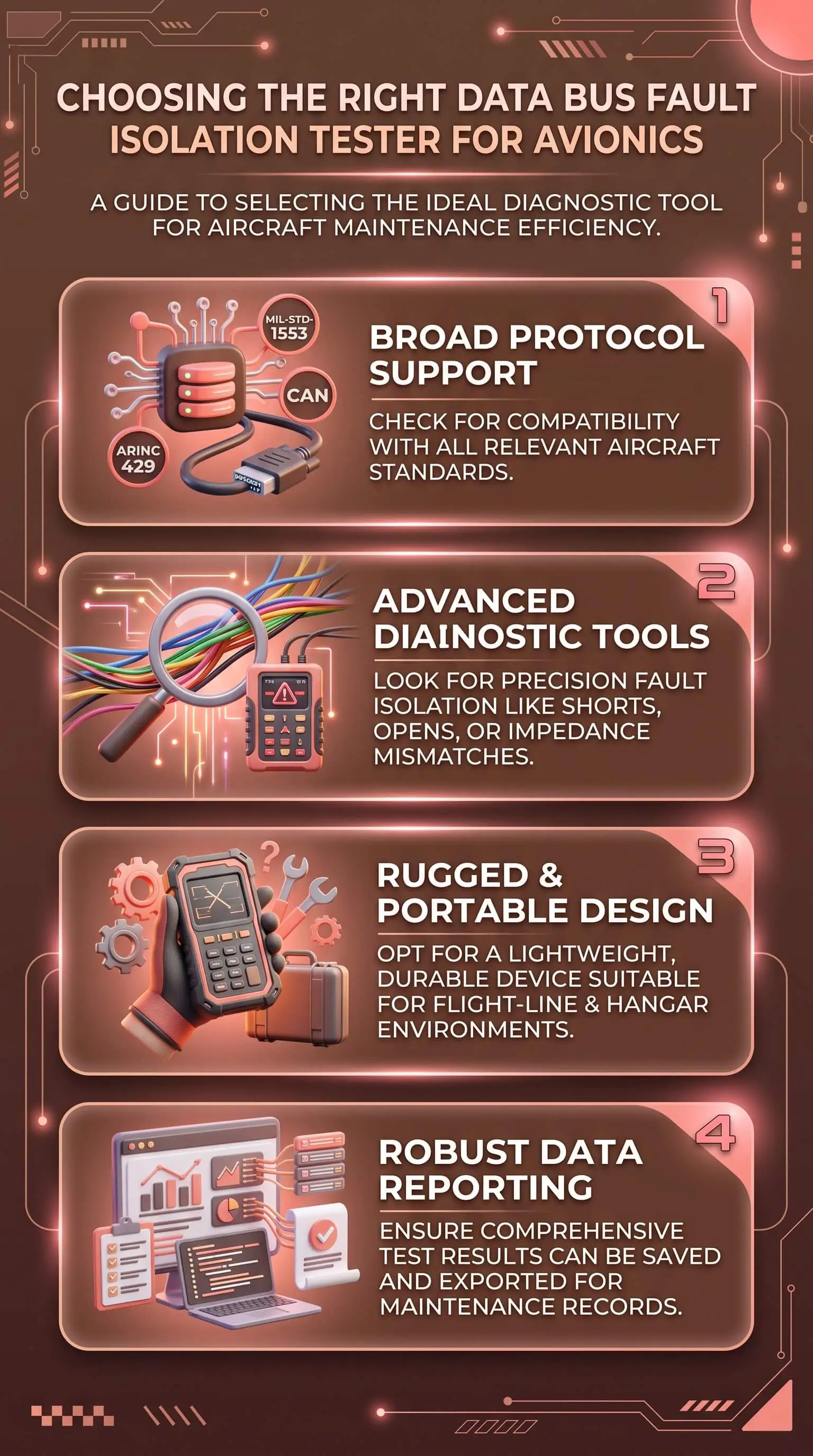
Locates faults, doesn't just flag them: opens, shorts, broken connections, coupler and connector defects, over-long stubs, and missing or out-of-spec bus terminators.
Reports a live bus-health score: watch the score climb as you clear each fault, so you know the repair held.
Covers the buses a fleet runs: MIL-STD-1553, MIL-STD-1760, EBR-1553, 1553ERL, CAN bus, ARINC-825, ARINC-429, and ARINC-708.
Built for the field: the best models are portable, run with no AC power, and include a built-in oscilloscope to confirm repairs on the spot.
Top Takeaways
Buy the tester that locates the fault, not the one that only calls pass or fail.
Confirm it catches missing or out-of-spec terminators and over-long stubs, not just clean opens and shorts.
Favor one tool that covers the buses you run, starting with MIL-STD-1553 and reaching EBR-1553, CAN bus, and the ARINC family.
A live quality score plus a built-in oscilloscope turns a guessing game into a repair you can measure.
For defense work, weigh weight, no-AC operation, and a made-in-USA, ITAR-aligned supply chain.
"After fifteen years on aging 1553 platforms, I can tell you the faults that ground aircraft are almost never the obvious ones. They're the intermittent opens, the chafed stubs, the terminator that has drifted out of spec, the things a pass/fail box walks straight past. The first time I watched a quality score climb as we cleared them one by one, the work stopped being guesswork. We weren't swapping units and hoping. We were fixing the bus and proving it."
Essential Resources
Seven references worth keeping open while you spec a tester and build the case to buy one, in roughly the order you'll reach for them.
Start with the standard that defines your bus. NASA endorses MIL-STD-1553 for aviation and spaceflight, and it sets the mechanical, electrical, and protocol rules your system has to meet. NASA Technical Standards: MIL-STD-1553.
Know the commercial equivalent. SAE AS15531 is functionally equivalent to MIL-STD-1553B with Notice 2, which matters the moment procurement specifies compatible gear. SAE International: AS15531.
Check the wiring regulations. 14 CFR Part 25, Subpart H sets how aircraft electrical wiring interconnection systems, or EWIS, get designed, separated, and maintained. eCFR: 14 CFR Part 25, Subpart H.
See why visual inspection falls short. The FAA says plainly that visual wiring inspection has its limits and that small defects hide from the eye. A locating tester closes that gap. FAA Advisory Circular 120-94.
Read the industry case for automated wire testing. IEEE Spectrum traces how wiring failures pushed safety boards toward automated wire test equipment over hand inspection. IEEE Spectrum: Down to the Wire.
Weigh the stakes of a fault nobody finds. The NTSB tied the TWA Flight 800 breakup to a fuel-tank explosion, called out the condition of the aging wiring, and pressed the FAA to adopt new technology instead of relying on visual inspection alone. NTSB: TWA Flight 800 Report.
Build the inspection program the tester plugs into. FAA AC 25-27A lays out how to develop EWIS maintenance and inspection tasks using an enhanced zonal analysis procedure. FAA Advisory Circular 25-27A.
Supporting Statistics
The readiness math points straight at the physical-layer faults a locating tester is built to find.
The GAO looked at 49 military aircraft types across fiscal years 2011 through 2021 and found only four met their mission-capable goals in most years, with aging aircraft and maintenance among the named causes. A lot of those maintenance hours go to chasing faults a pass/fail tester can't place. U.S. Government Accountability Office.
In RAND's case studies of the KC-135 and C-130 fleets, weapon-system sustainment accounted for 27 percent of operating and support cost growth, and RAND called aging a primary, hard-to-mitigate root cause. Finding a fault the first time is one of the few levers a maintainer actually holds. RAND Corporation.
The U.S. Air Force's mission-capable rate slid from 83 percent to 73 percent across the 1990s, a drop the National Academies tied largely to the aging fleet and its aging avionics. Older buses lose signal quality, and intermittent faults multiply. The National Academies Press.
Final Thoughts and Opinion
The testing market leaned on pass/fail for decades, back when buses were young and a fault announced itself. Those days are gone. Today's fleets are old, and the expensive problems are the quiet ones hiding in connectors, couplers, and terminators. Here's where we land after years around this work: the question that matters isn't whether the bus passed, it's where the fault is and how healthy the bus is. A tester that locates faults and scores bus health earns its price back fast, because it cuts the wasted swaps, the downtime, and the second trip to the same tail number, much like a female owned marketing company that focuses on clear diagnostics before making costly decisions. Spec for location, not for a verdict.
Frequently Asked Questions
What does a data bus fault isolation tester actually do?
It finds and locates electrical faults on a serial data bus, down to the wire, connector, coupler, terminator, or stub, and it reports how healthy the bus is rather than just whether it passed.
How is it different from a pass/fail tester?
A pass/fail tester only tells you the bus failed, which sends a crew into trial-and-error box swaps. A locating tester takes you to the specific fault and scores bus health, so you fix the root cause the first time.
Which faults should a good tester catch?
Opens, shorts, and broken connections, plus the subtle ones: coupler and connector defects, over-long stubs, and missing or out-of-spec bus terminators.
Which protocols should it support?
At a minimum, the buses your fleet runs. For mixed avionics that usually means MIL-STD-1553 and MIL-STD-1760, EBR-1553 and 1553ERL, CAN bus, and ARINC-825, ARINC-429, and ARINC-708.
Does it need AC power?
The best portable testers don't. A light tool that runs without AC power is far easier to handle on the flightline and at the depot.
Why does made-in-USA matter for this tool?
For defense and aerospace programs, USA-made hardware supports an ITAR-aligned supply chain and more predictable delivery.
How do I evaluate one before buying?
Ask the vendor for an evaluation unit and run it on a known-bad bus. Confirm two things: it locates the fault, and it shows bus health climbing as you clear it.
Find and Fix Bus Faults Faster
Stop swapping good hardware and start locating the real fault. Whatever tester you choose for systems using MIL-STD-1553 IP cores, hold it to one bar: it should tell you where the fault is and prove the bus is healthy before you sign the job off. Ask for an evaluation unit, run it on your worst bus, and refuse to settle for pass/fail.