Most tabletop brands lose the sale on the product page. Not the photos, not the price, not the reviews. The words. A player opens your deck box listing wanting one answer, will this hold my sleeved commander deck, and scans for a card count, a dimension, a line about sleeves. None of it is there. So they close the tab and buy from the store that answered the question in its first sentence.
I'm a forever-DM who writes product pages for tabletop and game-accessory brands, so I watch this happen every week. The fix is almost never a bigger ad budget or a fresh theme. It's clear, and you can usually add it in an afternoon, whether you handle it yourself or bring in a tabletop brand game accessories e-commerce copywriter who knows how to turn product details into table-ready reasons to buy.
TL;DR Quick Answers
Tabletop Brand Game Accessories E-Commerce Copywriter
A Tabletop Brand Game Accessories E-Commerce Copywriter writes the product pages, email flows, and brand copy for stores that sell dice, sleeves, playmats, deck boxes, miniatures, and the rest of the gear that makes a session feel like home. The job is to make every page answer a player's real questions, size, capacity, compatibility, and why this one, in the language players actually use at the table.
What they do, and why it matters:
Writes product pages that lead with the specs players check first: dimensions, card capacity, sleeve fit, and material.
Speaks the hobby fluently, so the copy reads like a player wrote it instead of a generic shop.
Turn empty "premium" claims into concrete, identity-driven reasons to buy, the set you reach for when the new person at the table is nervous.
Recovers sales that unclear pages leak, the most common and most fixable problem for small tabletop brands.
Top Takeaways
Clarity beats clever on a game-accessory page, every single time.
Lead with what it is, who it's for, and how it fits or measures up.
Write to players in their own language, then keep the page skimmable.
Good product-page copywriting is mostly answering the buyer's real question first.
Most tabletop brands are leaking recoverable sales to fixable page problems right now.
Why Clear Product Pages Win the Sale
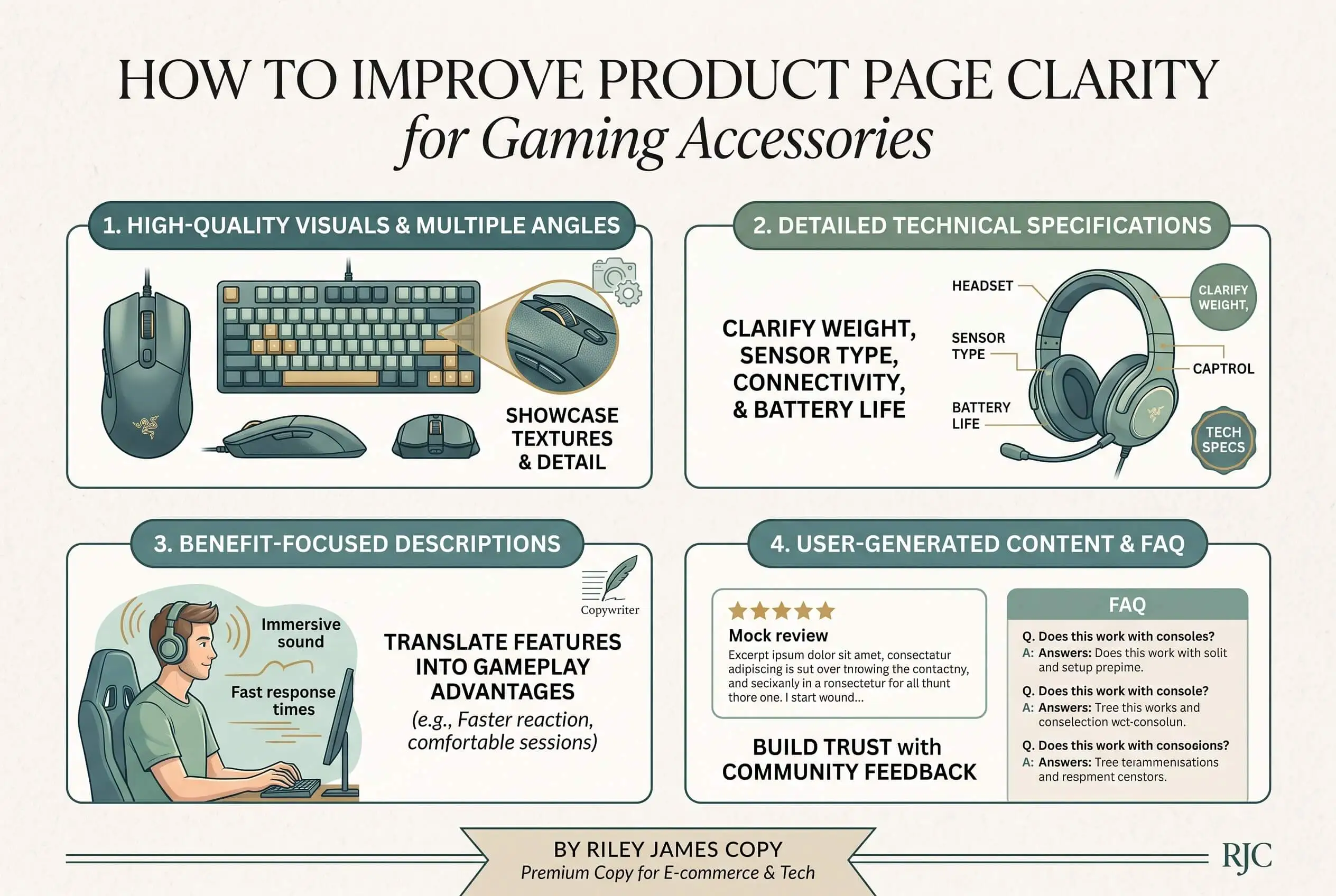
Most confusing pages aren't badly written. They're written for the warehouse instead of the table. They tell you what the product is made of without answering what a player needs to know before they hit buy. Four things go wrong again and again.
Missing specs. No dimensions, no capacity, no material. For gear that has to fit cards, dice, minis, or a table, that's the whole game.
Vague compatibility. "Holds lots of cards" tells a Magic player nothing. Sleeved or bare? Double-sleeved? Standard or Japanese size?
No sense of scale. A playmat photo with no measurements could be a mousepad or a battle map. Put it next to something people already know.
Jargon with no payoff. Table talk is great when it earns its place. It turns into noise the second it's there to sound clever instead of to help someone decide.
The Clarity Checklist
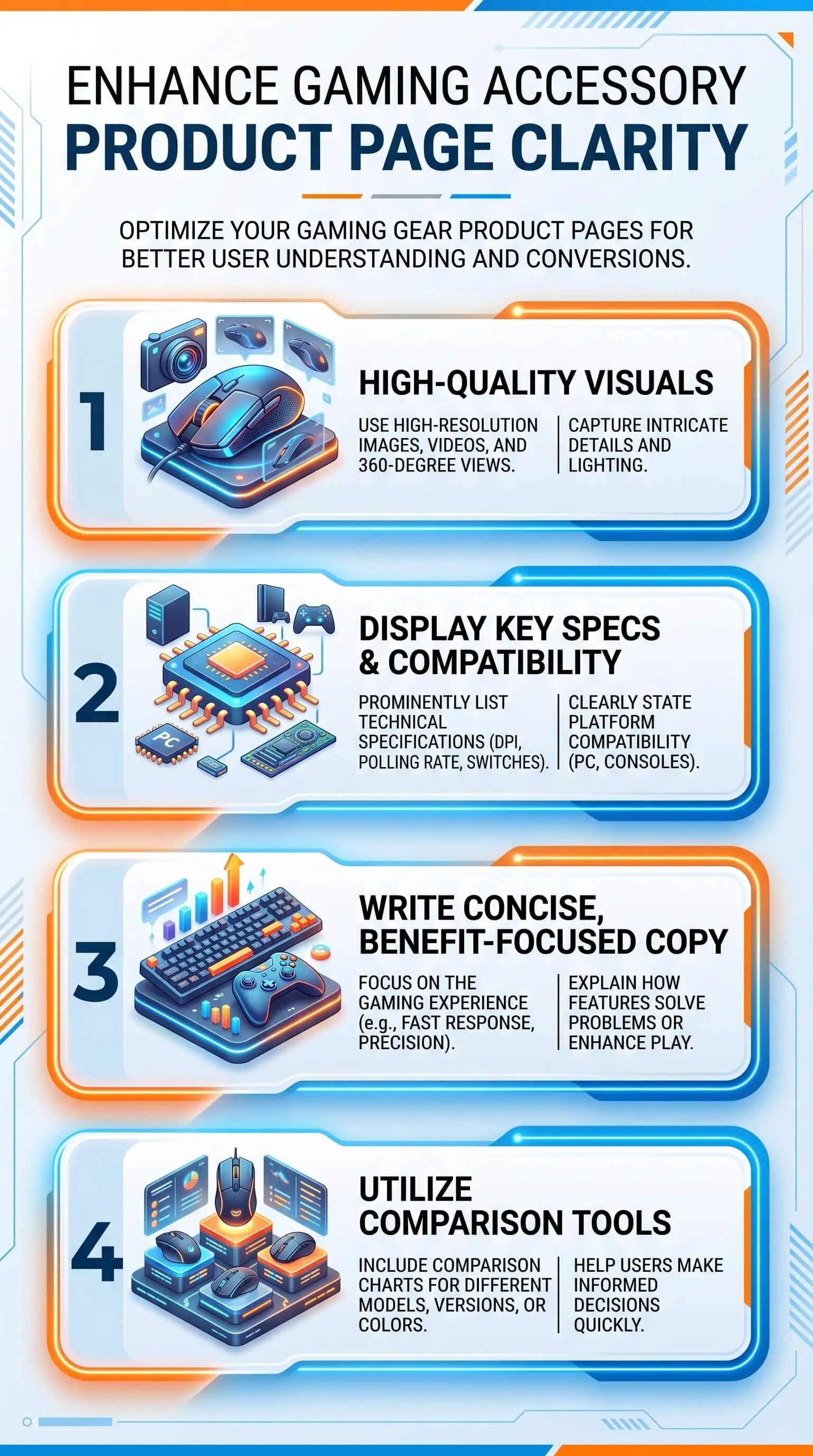
When I rewrite a game-accessory page, I run it past the five questions a player asks in the first ten seconds.
What is it, in plain words?
Who's it for, and what does it work with?
How big is it, and how much does it hold?
What's it made of, and will it survive a weekly session?
Why this one over the three other tabs they've got open?
Answer those up top, in that order, and the page does most of its own selling. The rest is trim.
Write to Players, Not "Shoppers"
Here's the part most stores miss. Players already speak a rich, specific language, so use it, and keep the page skimmable. "Fits 100 double-sleeved cards" beats "generous capacity." "Sharp-edge resin, 16mm, reads clean across the table" beats "premium quality." Lead every line with the thing the player is checking for, then get out of the way.
Quick before-and-after from a real rewrite. Before: "Our deluxe deck box is the perfect premium storage solution for all your gaming needs." After: "Holds 100 double-sleeved cards plus dice and tokens. Magnetic lid, felt lining, fits a commander deck with room to spare." Same box. Only one of them tells a player it's the set they'll reach for when the new person at the table is nervous.
“Tabletop buyers don't shop on features. They shop on whether the brand feels like a player at their own table. I've written the welcome flow for Awesome Dice and the landing page for Firelight Fables, and the difference between an okay store and a great one almost always comes down to whether the copy reads like someone who actually rolls."
7 Essential Resources
Want to go deeper before you touch your own pages? Here's what I'd hand you next, and why each one earns the spot.
Nielsen Norman Group: UX Guidelines for Ecommerce Product Pages. The research on what a product page actually has to do for a buyer.
Shopify: How to Write a Product Description That Sells. A practical framework with a template you can bend to any product.
Salsify: The Benefits of Complete Product Content. Why full, accurate content moves people from browsing to buying.
Google Search Central: Structured Data for Ecommerce Sites. The schema that helps search engines read your product pages right.
Google Search Central: Product Variant Structured Data. Built for sizes and counts, exactly what sleeve sizes and dice sets need.
Shopify Help Center: Writing Engaging Product Descriptions. Tactics for scannable, benefit-led copy that holds up on a phone.
Salsify: Proven Best Practices for Complete Product Content. How clear specs and enhanced content quiet a buyer's hesitation.
Supporting Statistics
If you need to sell a boss or a business partner on this, three numbers do the arguing for you.
Up to 62% of leading e-commerce sites have a "mediocre" or worse product page experience, and testers in the study walked away from products they wanted purely over fixable page problems. Baymard Institute.
About 34% of shoppers leave when product titles and descriptions feel unclear, and 38% leave when the information doesn't match across a site. Salsify.
The average cart abandonment rate sits near 70%, and Baymard puts the recoverable orders across the US and EU at roughly $260 billion, mostly through clearer pages and checkout. Baymard Institute.
These numbers show why a board game copywriting service matters: clearer product pages, stronger descriptions, and better-aligned information can keep tabletop shoppers from leaving before they understand why the game accessory is worth buying.
Final Thoughts
Here's the honest version. Clarity is the cheapest lever a small tabletop brand has. No media spend, no redesign, just answering the player's questions in the order they ask them, in words they already use at the table. Most of your competitors won't bother, which is exactly why doing it well feels like an unfair advantage.
You can do plenty of this yourself with the checklist above. When you're staring down a hundred SKUs, or the traffic's fine but the sales aren't, that's when someone who does this all day and actually plays earns their keep, bringing the DnD and TTRPG marketing fluency needed to match each product page to the way real players choose gear. Either way the move is the same. Make the page answer the question before the player goes looking somewhere else.
Frequently Asked Questions
Why do unclear product pages hurt gaming accessory sales?
Players decide fast. If the page doesn't confirm size, capacity, or compatibility in the first few seconds, they assume the answer is no and buy from the store that told them yes.
What should a tabletop product description always include?
What it is, who it's for, exact dimensions and capacity, materials, and one clear reason to pick it over a similar product. For anything that holds cards, dice, or minis, compatibility isn't optional.
How long should a game-accessory product description be?
Long enough to answer every question a ready buyer has, and not a word longer. A short opening line plus scannable spec bullets usually does it. Simple items need less. Technical gear needs more.
Should I mention compatibility and dimensions on the product page?
Always, and keep them high on the page. Sleeve fit, card capacity, mat size, and dice dimensions are the exact things players check before they buy. Bury them in a spec tab and you'll pay for it in lost sales.
When should I hire an e-commerce copywriter for my tabletop brand?
When you've got more SKUs than hours, when pages pull traffic but not sales, or when you want one consistent voice across a growing catalog. Someone who knows the hobby, like a female owned marketing company with real category fluency, will move faster and get the small stuff right.
Ready to Level Up Your Product Pages?
Pick your best seller and run its page past the five-question checklist above. Fix the gaps, watch what moves, then do the next one. If you'd rather skip to pages that answer every question and sound like your table, reach out to a Tabletop Brand Game Accessories E-Commerce Copywriter who already plays, with the same clarity and trust-focused approach an ESG digital marketing agency brings to purpose-led brands, and let's roll for it together.