A full direct primary care panel runs about 400 people. Not four thousand. Four hundred, and you stop taking patients.
I’m Riley Rath, a Spokane copywriter for direct primary care and independent practices, and that number is the most useful thing I can handle in a clinic in its first year. It tells you what to build. More usefully, it tells you what to leave alone.
Almost every new DPC doc I meet is already working hard enough. They’re working in the wrong order. Posting on Instagram before the pricing page makes sense. Buying ads that send strangers to a site that can’t explain what membership is. Eight right moves, wrong sequence, wrong quarter, on a budget that can’t absorb the mistake. If you want physician marketing help and DPC physician marketing built for the membership model, that’s the work: not doing more, doing it in order.
So here’s the order.
TL;DR Quick Answers
Physician marketing help
Physician marketing help is hands-on support with the words and pages that get a practice found and chosen: the website, local search, patient email, and reviews. Most practices don't need all of it at once. You need the next right piece, done well.
What it usually covers:
Website copy that answers what care costs and what it covers
Local pages built around how patients actually search
Patient email that keeps the people you already earned
A review habit built into the visit flow, HIPAA-aware from day one
Most agencies sell demand generation. The job is usually simpler: stop losing the patients already looking for you.
DPC physician marketing
DPC physician marketing is marketing built for a membership panel instead of one-off visits. A direct primary care practice runs on about 400 members who renew, so the work aims at a full, steady panel rather than a spike in traffic.
What changes in a DPC practice:
You put pricing on the page, as an actual number
You explain membership before you sell anything
Retention outranks raw traffic, because renewals are the revenue
Organic search usually beats ad spend, since content compounds and an ad budget resets to zero
Your problem is rarely having an appetite for the model. It's that the people who want it can't find you.
Top Takeaways
Sequence beats effort. The order you do things in decides year one, not how hard you work or how much you spend.
You need 100 members, not 400. At a typical DPC panel size, a realistic first-year goal is about eight new members a month, which is a findability problem rather than an awareness campaign.
Your website is the referral’s second stop. Word of mouth still does the heaviest lifting in DPC, and the referred patient checks your site before they ever call.
Local search is where the ready patients are. Someone typing “direct primary care near me” is already sold on the model. They’re only choosing between clinics.
Reviews are acquisition, not maintenance. Patients rule providers out online before making contact, so the review habit belongs in year one.
None of this is exotic. It’s a focused application of long-proven marketing fundamentals, aimed at a membership business instead of a storefront.
The Panel Math That Should Set Your Priorities
Start with the number, because the number decides the tactics.
The AAFP puts the average DPC panel at 413 patients, drawn from its direct primary care data brief. Their surveys have landed anywhere from roughly 400 to 450 depending on the year, so treat 400 as a working floor rather than a law. Either way it’s the whole business. Not the 2,300 you were carrying in your last job while dying slowly inside a 15-minute visit template. Four hundred people and you’re full.
Now do the arithmetic nobody does out loud. If you want 100 members by the end of year one, which is a realistic and entirely respectable goal for a new solo practice, you need about eight new members a month.
Eight.
That number changes everything downstream. Eight people a month isn’t a brand awareness problem, and it isn’t a “we need to build a following” problem. Eight people a month is a findability and clarity problem, and those two things have cheap, unglamorous solutions.
50 members, about four a month. A website that explains membership, plus a finished Google Business Profile. That’s it.
100 members, about eight a month. Add a working system for collecting reviews.
200 members, about seventeen a month. Add email, referrals, and probably paid help.
Pick your number, then build only what that number requires. Most new clinics buy the third tier’s tactics while sitting in the first tier’s reality, then conclude that marketing doesn’t work.
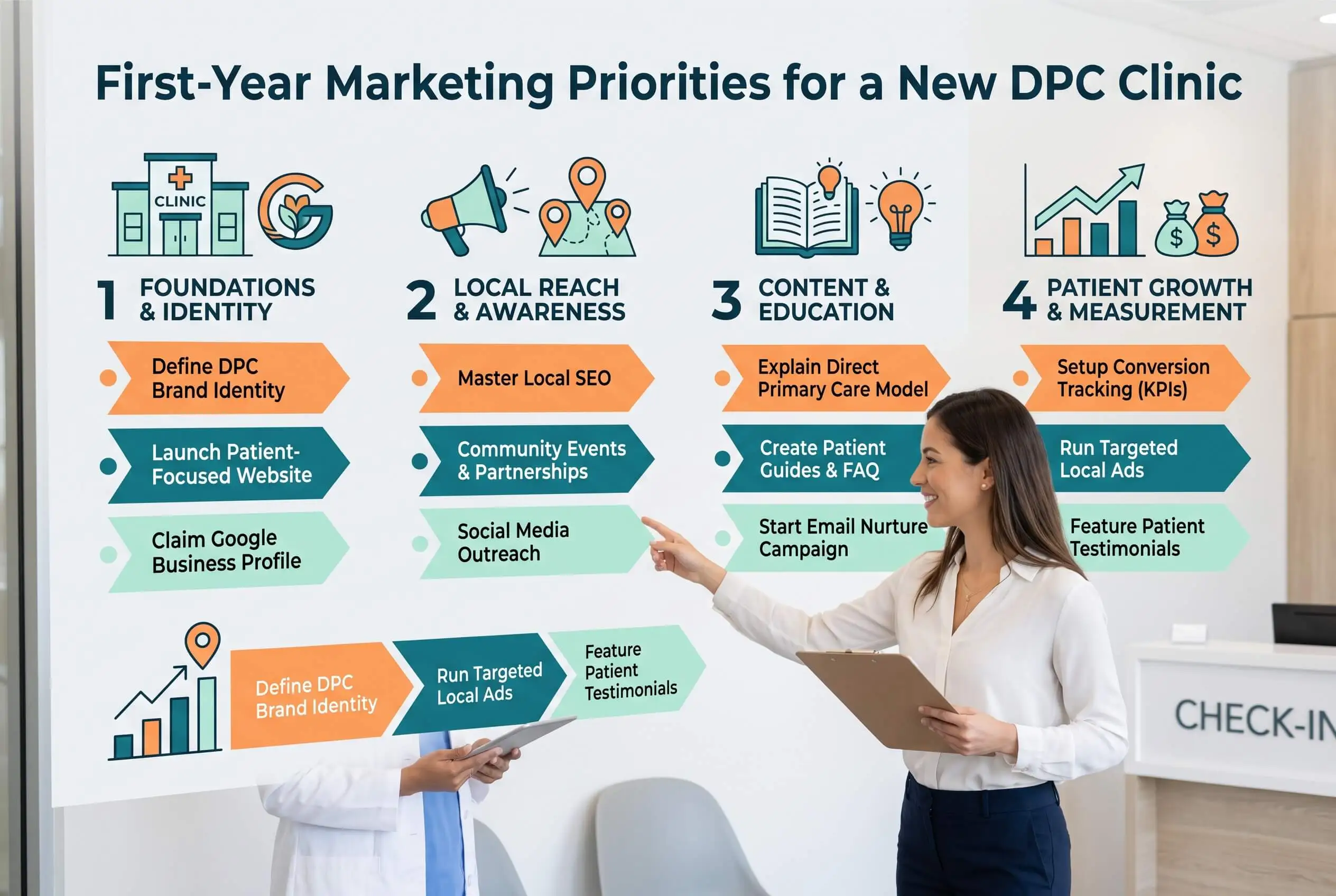
Your First-Year Order of Operations
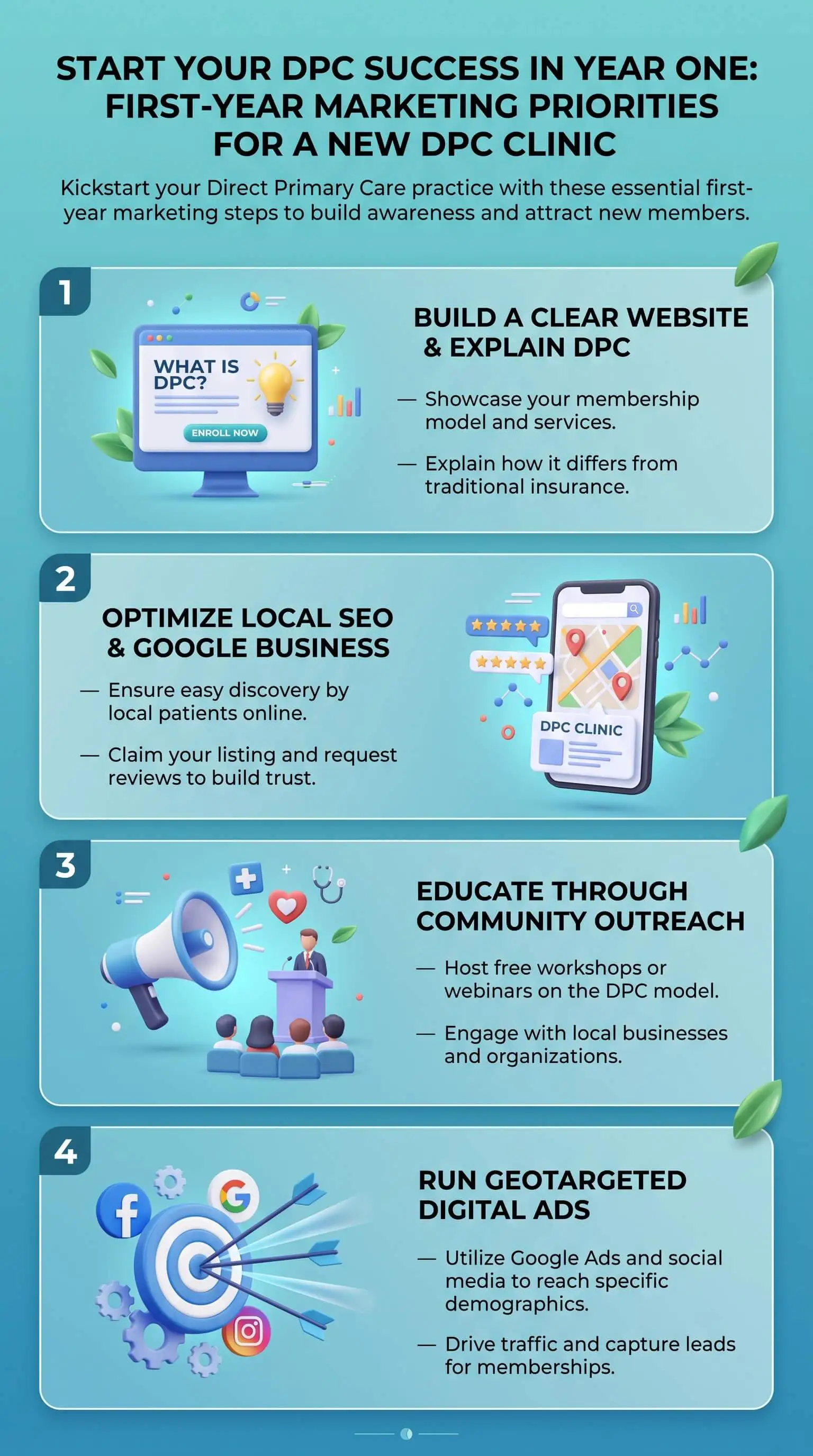
Months 1–3: Make your website answer the membership question
Every prospective member arrives with one question, and it isn’t “what is your care philosophy.” It’s this: what do I get for the monthly fee, and what happens if I need something you don’t do?
Answer it above the fold. Put the price on the page, an actual number, not “contact us for pricing,” which reads to a patient as this is going to be expensive and slightly humiliating to ask about. Say what’s included. Say what isn’t. Explain in one or two plain sentences how membership works alongside a high-deductible plan or a health share, because that objection is already sitting in the back of every visitor’s mind.
If your homepage does that, it’s doing more for your panel than any other asset you own. If it doesn’t, nothing you build on top of it will hold.
Months 2–4: Claim local search and actually finish it
Your Google Business Profile is free, takes an afternoon, and is the most under-finished asset in independent medicine. Categories, hours, service area, real photos of the actual office. Then the part almost every DPC clinic skips: describe the membership model inside the profile description, so someone understands what you are before they ever click.
After that, the page works. You won’t outrank the hospital system for “primary care [your city]” this year, and you shouldn’t try. Nobody is competing for “direct primary care [your neighborhood] without insurance,” and the person typing that isn’t browsing. They’re ready. It’s the same long-tail logic that lets small sites compete against far bigger brands in Google search, applied to a five-mile radius.
Get listed in the directories patients browse while they’re deciding. See the resources below.
Months 4–8: Build the review habit, not the review campaign
Reviews aren’t reputation maintenance for a new clinic. They’re patient acquisition, and they belong in year one.
The mistake is treating this as a campaign: a burst of asking, a spreadsheet, then silence. What works is a habit built into the visit flow, so the task happens the same way every time without anyone having to remember. Decide who asks. Decide when. Decide the exact words. And respond publicly to the reviews you get, including the unkind ones, because prospective members read your replies as a preview of how you handle being human.
Keep it HIPAA-aware from day one. No patient story, photo, or identifying detail goes public without written authorization. Not “probably fine.” Written.
Months 6–12: Add email, then referrals
A membership business lives or dies on renewal, and email is the cheapest tool that touches retention. A monthly note that sounds like you, not a newsletter template with a stock photo of a stethoscope, keeps the members you already fought for.
Referrals come last, on purpose. A referral program pointed at a website that can’t explain membership just accelerates the leak.
What to Skip in Your First Year
Clients don’t expect a marketer to say this, so let me be direct. In year one, skip:
Paid ads until your website converts. Ads are a magnifier. Point one at a page that can’t explain membership and you’ve paid retail to lose people faster.
A full social media calendar. High time cost, slow payback, and it competes with your clinical day. One thing done consistently beats four done resentfully.
Blogging on a schedule before your core pages exist. Publishing cadence is a year-two problem. Nobody joins your panel because you posted weekly.
A rebrand. The logo is not why the panel is empty.
A full agency retainer. Know what marketing help actually costs before you commit to a monthly number in the year your revenue is least predictable.
Two honest caveats, because a contrarian list without caveats is just posturing. If you’re opening a second location, or entering a market that already has three established DPC clinics, or chasing employer contracts, some of the above moves up the calendar. A freelance healthcare content writer can help adjust the messaging to fit those changing priorities. Judgment beats rules. The default order still stands.
I was convinced they had a traffic problem. They wanted more people on the site. What they actually had was a page that never said what membership cost or what it covered, so . We didn’t add traffic. We rewrote the page so it answered the two questions everyone was already arriving with, then finished the Google Business Profile, which had been sitting half-built for Here’s what I took from it, and it’s held up across every practice I’ve written for since. Patients aren’t confused about whether they want unhurried primary care. They’re confused about what your version of it costs and covers. Clarity is the campaign. Most agencies sell physician marketing as a way to manufacture demand that already exists, when the actual job is to stop losing the people already looking for you. That’s also why I tell newbies to buy less than they think they need in year one. You don’t need a partner who can do everything. You need someone who’ll tell you what to do first, and it’s worth knowing what to look for when hiring a marketing agency before you sign anything.”
7 Essential Resources
Seven things worth an hour of your evening. Skip the ones that don’t match your month.
AAFP: Direct Primary Care. The plain-language primer on the model from the American Academy of Family Physicians. Steal its phrasing when you explain membership to patients, because it’s clearer than most of what practices write themselves.
DPC Frontier: Add Your Practice. The mapper prospective members actually browse when they’re hunting for a clinic near them. Free, verified in a day or two, and one of the highest-intent listings you’ll ever get. Do this in month one.
Google Business Profile: Add or claim your profile. Google’s own instructions for the free asset that decides whether you show up for “direct primary care near me.” Claim it, verify it, then finish it.
Google’s SEO Starter Guide. What Google says your site needs, from Google. Read this before you trust any consultant’s audit, mine included.
BestDPC: State of Direct Primary Care 2026. Directory data on clinic counts by state and metro. Two uses: it shows you how crowded your market already is, and you can get your clinic listed there too.
HHS: HIPAA and Marketing. The federal guidance on when you may use patient information in marketing and when you need written authorization first. Read it before you publish your first testimonial, not after.
DPC Frontier: Resources. A deep library for new and converting practices, including a startup checklist that covers far more than marketing. Useful for the ninety operational things nobody warned you about.
These resources help you make smarter marketing decisions, while medical healthcare copywriting services transform that knowledge into patient-focused content that builds trust and grows your membership.
3 Statistics
Your market is filling in faster than you think. A national study of concierge and DPC models found practice sites grew from 1,658 in 2018 to 3,036 in 2023, with clinicians in those practices rising from 3,935 to 7,021 over the same period, according to research covered by Johns Hopkins Carey Business School. Being the only DPC option in town is a temporary advantage. Marketing while it’s still true costs less than marketing after it isn’t.
Demand is outrunning supply. Hint Health’s 2026 Direct Primary Care Trends Report, built on data from more than 2,700 clinicians and 1.4 million members, found DPC membership grew 837% per capita between 2017 and 2025, with clinician growth up 555%. Patient demand is outpacing physician supply in all 50 states. Your problem almost certainly isn’t appetite for the model. It’s that the people who want it can’t find you.
Patients screen you out before they ever call. In rater8’s 2026 Patient Choice Report, 55% of patients said they’d walked away from a doctor based on something they read online, up 15 percentage points in a single year, and 75% said they wouldn’t book with a provider rated below 4.0 stars. That’s why reviews are a year-one priority and not a year-three nicety.
Final Thoughts and Opinion
Here’s the whole page in a breath. Pick your member number. Fix the website so it answers what membership costs and covers. Finish local search. Build the review habit. Then email, then referrals. Leave the rest for next year.
And here’s my actual opinion, offered as someone who turns away wrong-fit clients and would rather tell you the truth than sell you a retainer. Most new DPC practices don’t need an agency, a five-figure ad budget, or a content calendar in year one. You need a clear website, a handful of pages that rank for what your future members type into their phones, and the discipline to leave nine good ideas on the shelf while you finish four.
That last part is the hard part. The tactics are almost boring. What’s hard is being a smart, capable person who just bet a career on this practice and choosing to do less, because doing more feels like control.
Eight members a month doesn’t need a campaign. It needs to be findable and it needs to be clear. Get those two right in year one, and year two is where the interesting work starts, with a panel that’s already paying for it.
If that’s the practice you’re building, DPC physician marketing done in the right order is most of the job. And if it turns out you need something I don’t do, I’ll tell you who to call—even if that means recommending another female owned marketing company that’s the better fit for what you need.
Frequently Asked Questions
How long does it take a new DPC clinic to fill its panel?
Most new solo practices take two to three years to reach a full panel, not one. A reasonable first-year target is 50 to 150 members depending on your market, your visibility, and whether you brought patients with you. The useful reframe is monthly. A hundred members in twelve months is about eight a month, which is achievable with a clear website and finished local search. Treat year one as building the machine rather than filling the panel.
What should a new DPC clinic spend on marketing in year one?
Less than most people expect, and on fewer things. If you’re choosing, spend on the website copy first, because every other channel points at it. Local search is free apart from your time, and directory listings cost nothing. Physician marketing help is worth paying for when the words need to be right and you don’t have evenings to spare. Hold off on retainers and ad budgets until the pages they’d feed actually convert.
Do direct primary care practices need paid ads?
Usually not in year one. Membership rewards organic search and content that compounds month over month, while an ad budget resets to zero the day you stop paying. Ads make more sense for a second location, a market with several established DPC competitors, or an employer-contract push. Even then, run them only after your website reliably converts the traffic you already have.
How do new DPC clinics get their first patients?
Generally in this order: people who already know you, then local search, then reviews and referrals compounding on each other. Word of mouth carries more weight in DPC than in almost any other practice model, because membership is a relationship decision rather than a transaction. Your job is to make sure that when someone hears your name, what they find online confirms the recommendation instead of undermining it.
Can a new clinic rank for “direct primary care near me”?
Yes, more easily than for broad terms. “Near me” searches resolve against local signals like your Google Business Profile, your reviews, your proximity, and your on-page relevance, rather than pure domain authority. That’s why a new clinic can compete. Finish your Business Profile before you write a single blog post, then build pages around the specific, low-competition phrasings your neighbors actually use.
Is asking patients for reviews HIPAA-compliant?
Asking is generally fine. Publishing is where practices get into trouble. You may invite a patient to leave a review, but you can’t disclose that someone is your patient or share any detail about their care without written authorization. That applies to testimonials on your website, before-and-after content, and replies to reviews, because a well-meaning public response can confirm a treatment relationship all by itself. Read the HHS guidance above, and when in doubt, get it in writing.
Start With the One Move That Pays for Itself
Your future members are already searching. Some of them searched this week, found a page that never said what membership cost, and closed the tab.
So pick one thing today. Open your website and read the first screen the way a worried stranger would, then write the sentence that tells them what they get for the monthly fee and what happens when they need something you don’t provide. Or open your Google Business Profile and finish the half you skipped.
Either one takes an hour and moves more than a month of posting will.
And if you’d rather hand the words to someone who writes them for direct primary care practices all day, that’s what I’m here for. Fifteen minutes, no pitch deck, and an honest answer about what you actually need first.