In December 2023, Allstate told its Colorado agents to stop advertising, quoting, and selling in any language but English. A new state law required insurers to offer policy documents in the language they advertise in, and the carrier chose English-only sales over translation. Spanish-speaking customers lost a familiar option almost overnight.
Colorado's story is a planning lesson for every agency. Most of the trouble we see starts in the gap between an ad and everything that follows it. Picture a Spanish-language auto ad that gets the culture exactly right, then links to an English-only quote form. Diverse households make up a growing share of every agency's market, yet plenty of agencies sit out in-language marketing because the compliance side feels murky.
At its best, multicultural marketing treats diversity as an asset to build on. It grows out of multiculturalism, the idea that many cultures can share one society without being flattened into a single profile. For an insurance agency, that means shaping your message around a community's language, values, and everyday priorities instead of translating one generic ad. You can't sort customers into one tidy category anymore. Agencies that stop trying usually write more business.
Whether you build this capability in-house or bring in one of the top multicultural marketing agencies, start with the rules, because the most powerful thing about branding yourself is building trust through cultural understanding. They shape every creative decision after that.
TL;DR Quick Answers
Top Multicultural Marketing Agencies
The top multicultural marketing agencies build campaigns from inside the communities they want to reach. They staff native-speaker creative teams, keep working relationships with community media and leaders, and treat diversity as a growth asset. For insurance brands, the best partners also know regulated advertising, so cultural relevance never gets ahead of compliance.
What sets them apart:
Cultural roots on the team: strategists and writers who share the audience's language and background
Transcreation over literal translation: messages adapted for idiom and tone, with a locked glossary for insurance terms
Regulated-industry experience: past work in insurance, banking, or healthcare
A built-in compliance step: in-language drafts reviewed in their final form before launch
Community reach: ties to local media, organizations, and trusted influencers
Segment-level reporting: results broken out by language and channel
Before you hire one, ask who translates, who reviews, and which regulated campaigns they've run.
Top Takeaways
A translated insurance ad answers to the same advertising rules as the English original.
Some states only ask for an English-only policy disclosure on in-language ads. Colorado requires documents in the advertised language for auto, home, and renters coverage.
Skip race-based ad targeting, especially for homeowners insurance. Target by interest, language preference, and broad geography.
Transcreation backed by a locked insurance glossary beats word-for-word translation.
Keep one language from the first ad all the way to the signed policy.
Top multicultural marketing agencies bring native-speaker creative, community relationships, and a review workflow most insurance agencies don't have in-house.
How to Market Insurance Across Cultures Without Compliance Risk
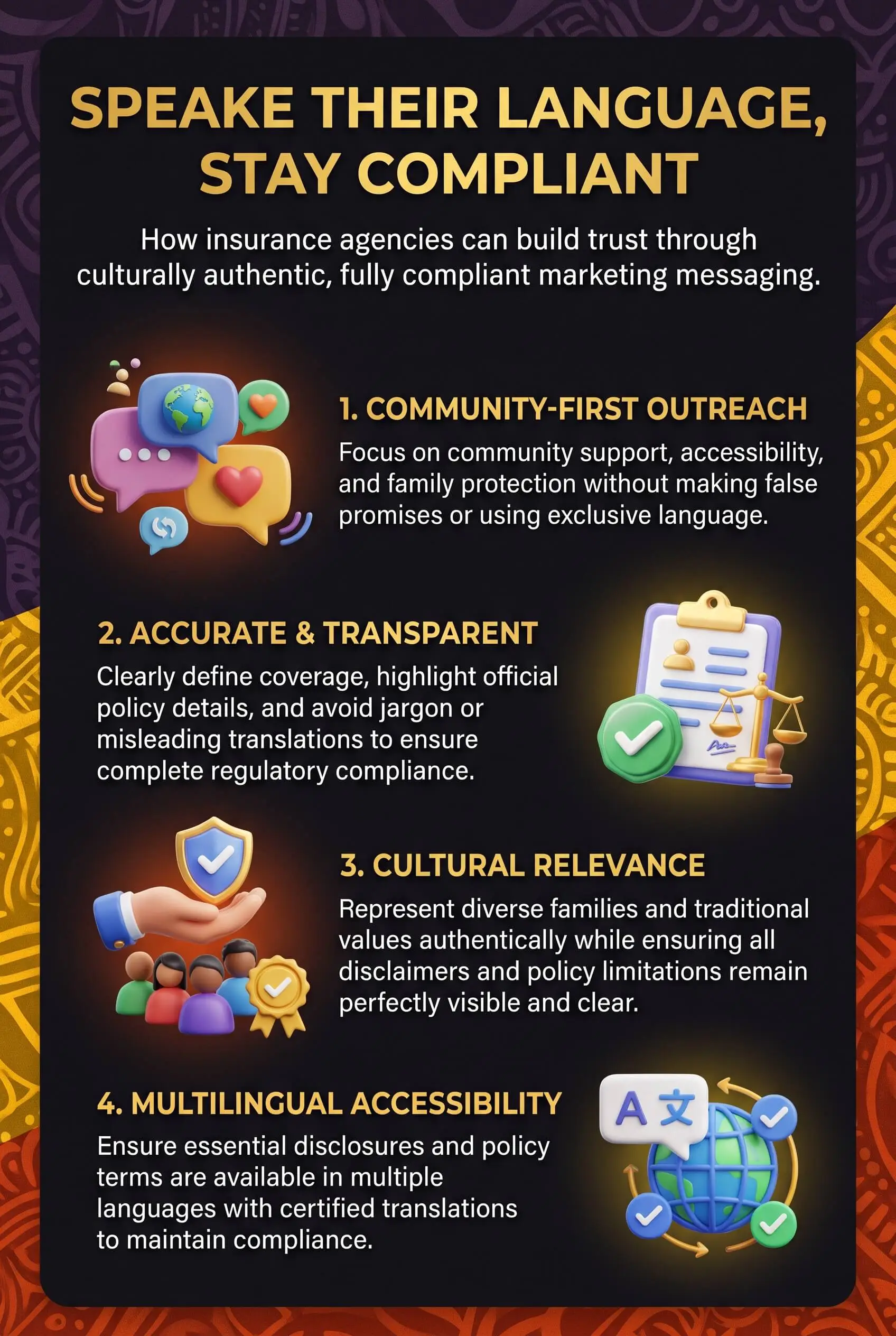
Multicultural insurance marketing holds up when the message fits the community and every claim survives your state's advertising rules, in whatever language the customer reads it. Get the culture right and the compliance wrong, and you've built trust you can't keep.
Why It Matters for Insurance Agencies Now
Census projections show non-Hispanic white Americans falling below half the U.S. population by 2045. Multiracial Americans are growing faster than any other group. Each of those households needs auto, home, renters, life, or health coverage, and most would rather hear about it from someone who speaks their language and understands what their family is trying to protect.
Insurance buyers choose agents they believe are honest. That belief forms faster when the agent shows up at the same neighborhood festival and answers the phone in the customer's first language. It also forms when the agency treats the community as a lasting relationship instead of a one-time campaign. When reputable agencies go quiet, someone else fills the space. Critics of the Colorado pullback warned that less scrupulous sellers would step in.
The Rules That Apply in Every Language
Translating an ad doesn't change how a regulator sees it. States regulate insurance advertising one by one, and most of them build on models from the National Association of Insurance Commissioners (NAIC).
Unfair Trade Practices Act (Model 880) bans misleading statements in advertising by anyone in the business of insurance.
Advertisements of Life Insurance and Annuities (Model 570) requires life ads to name the product clearly and separate guaranteed features from non-guaranteed ones.
The NAIC also wrote separate rules for Medicare supplement ads (Model 660), which matter if your outreach includes older customers.
State language laws add another layer. Idaho lets insurers advertise in another language as long as the ad says plainly that the insurer issues the policy only in English. Colorado went further with HB23-1004, which took effect January 1, 2024. Auto, home, and renters insurers that advertise in a language now have to offer professionally translated policy documents in that language, though the English version still controls any dispute.
Audience targeting deserves the same care. Picking ad audiences by race or ethnicity, especially for homeowners coverage, can raise fair housing and unfair-discrimination questions. We'd target by interest, language preference, and broad geography, then check each ad platform's rules for insurance and financial-services ads.
Build one more habit into every campaign. Your compliance lead should review the final in-language version, not only the English draft, and your team should keep every version on file.
Compliant Messaging Examples for Multicultural Insurance Campaigns
Side-by-side comparisons make the difference obvious. These six scenarios mirror the kinds of campaign reviews agencies run every week.
Spanish auto ad in a state that allows English-only policies. Risky: a Spanish ad that never mentions the policy language. Compliant: a Spanish ad stating, in Spanish, that the carrier issues the policy and documents in English, with a bilingual agent line right beside it.
In-language homeowners ads in Colorado. Risky: Spanish social ads running while the documents exist only in English. Compliant: hold the Spanish ads until your translated documents and language-selection form are ready.
Life insurance for a Mandarin-speaking community. Risky: "Coverage guaranteed, no medical questions." Compliant: call the product life insurance, say which parts the carrier guarantees, and explain what underwriting actually involves.
Homeownership month promotion. Risky: homeowners ads targeted by race. Compliant: broad interest and location targeting, imagery that looks like the neighborhood, and a local nonprofit partner.
Lunar New Year or Diwali event booth. Risky: "Free gift card when you buy a policy." Compliant: a small giveaway for every visitor with no purchase required, which you clear against your state's anti-rebating rules first.
Testimonial video with a community leader. Risky: scripted praise from a paid influencer who discloses nothing. Compliant: a policyholder speaking in their own words, disclosing any payment, with every claim approved by compliance in advance.
Each compliant version tells the customer exactly what they're buying and keeps one language from the first click to the signed policy. A cultural hook should never stand in for a material fact.
A Six-Step Process for Culturally Fluent, Compliant Campaigns
Learn the community before you write anything. Talk with customers, faith and civic leaders, and local business owners.
Hire and partner from within it. Bilingual producers and community advisors catch problems a translation tool misses every time.
Transcreate instead of translating word for word. Adapt the idea, and lock in a glossary so terms like deductible, premium, and beneficiary never drift.
Review the version customers will see. Compliance signs off on the final language, not the English source.
Match the whole journey. Your ad, landing page, phone line, forms, and documents should all speak the same language.
Measure, then adjust. Break results out by language and channel.
Want to see what resonant creative looks like? Our guide to culturally relevant ads has examples.
How Top Multicultural Marketing Agencies Support Insurance Brands
Few insurance agencies keep native-speaker copywriters, community relationships, and a compliance-aware review process under one roof. Partnering with one of the top multicultural marketing agencies closes that gap. The Sax Agency in Los Angeles shows how the model works. This minority-owned multicultural firm treats diversity as a core asset and draws on its team's cultural roots across strategy, public relations, social media management, and urban and event marketing.
When you compare partners, look for:
Creative and translation teams who speak your target languages natively
Experience in regulated industries like insurance, banking, or healthcare
A defined process for routing in-language drafts to your compliance team
Working relationships with community media, organizations, and influencers
Reporting that splits results by audience segment
Before you sign, ask who translates, who reviews, how they keep up with state-by-state rules, which regulated campaigns they've run, and how they'll report results. Still building a shortlist? Here's how to find multicultural marketing agencies in your area.
Measuring Results Without Crossing Compliance Lines
Track quote starts, bind rate, retention, and complaints by language and channel as part of brand identity development for small business. Rely on the language preference customers tell you rather than inferred ethnicity, and watch complaint trends as closely as sales. A campaign that sells well but confuses people tends to catch up with an agency later, often during a market conduct exam.
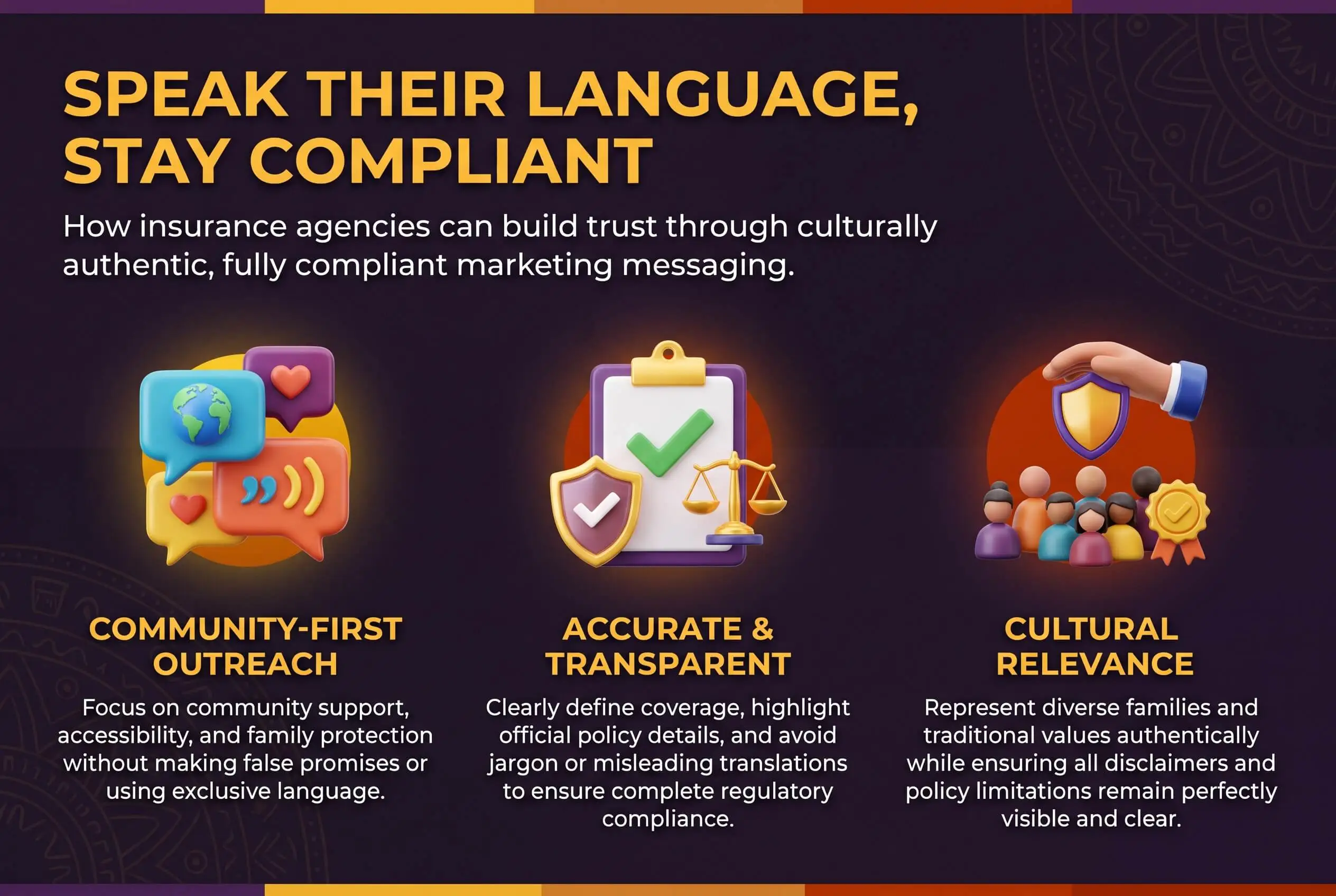
"Campaigns rarely fail on culture. They fail on the handoff. We've reviewed beautiful Spanish-language ads that sent people to an English-only quote form and a voicemail with no bilingual option. The customer feels invited in and then shut out, and the agency ends up explaining that mismatch to a regulator. The fix we keep coming back to is almost embarrassingly simple. Before any in-language ad goes live, ask someone from that community to walk the entire path, from the first click to the signed policy, and flag every spot where the language or the promise changes. That one walkthrough catches more compliance problems than any checklist we've used, and it's usually the moment a campaign starts earning trust."
7 Essential Resources
General Compliance Requirements for Insurance Advertising (Saifr): A plain-English walkthrough of how NAIC models, the Unfair Trade Practices Act among them, turn into state advertising rules.
Compliance Requirements for Life Insurance and Annuity Products (Saifr): Covers what Model 570 expects from life and annuity ads, down to how you describe a "no medical exam" policy.
NAIC Advertisements of Life Insurance and Annuities Model Regulation, State Adoption Chart: Check whether your state adopted Model 570 and which version it follows.
NAIC Medicare Supplement Advertising Rules, State Adoption Chart: Worth a look if older customers are part of your outreach.
Colorado HB23-1004 Language Access Summary (Hall & Evans): Lays out what Colorado's translation law requires, when it took effect, and why the English version still governs disputes.
Idaho 2007 Legislation on Non-English Insurance Ads (H0112): The original bill text behind Idaho's English-only policy disclosure.
Colorado's In-Language Policy Law and Insurance Marketing (Ansira): Practical advice for keeping a non-English campaign in one language from the ad through the landing page.
3 Statistics
Non-Hispanic white Americans are on track to drop below 50% of the U.S. population by 2045, according to Census projections that The Hill reported. The same reporting puts multiracial Americans on track to double between 2020 and 2050.
About 16% of Colorado residents speak a language other than English at home, based on 2022 Census figures that Insurance Business cited. That's the audience a carrier leaves out when it pulls in-language advertising.
96% of consumers said an agent's reputation for honesty mattered when buying life insurance, according to a Harris poll that PropertyCasualty360 reported in 2004. It's an older number, and the point behind it hasn't aged at all.
Census projections point to a more diverse U.S. population by 2045, while Colorado's multilingual households highlight the need for accessible insurance marketing. With 96% of surveyed consumers emphasizing honesty when choosing life insurance, a female owned marketing company focused on multicultural audiences can help insurers build trust through culturally relevant messaging.
Final Thoughts and Opinion
The bigger risk in multicultural insurance marketing is silence. A clumsy translation takes an afternoon to fix, but an agency that never shows up in a community's language loses those customers to whoever does.
Colorado shows how this plays out. HB23-1004 had the right goal, because people deserve to understand a policy in the language they think in. The response is where it went sideways. One of the largest carriers in the state chose English-only sales over translating its documents, and the customers the law meant to protect ended up with fewer choices. We'd argue agencies should plan for language access before launch instead of scrambling after a regulator asks.
Compliance and cultural connection pull in the same direction far more often than people expect. Clear product names and honest claims, delivered in one language from ad to policy, earn trust in communities that brands have overlooked or oversold for years. Agencies that treat diverse customers as long-term relationships will own the next decade of growth.
Rules vary by state and line of business, so run every campaign past your compliance team or state department of insurance before it goes live.
Frequently Asked Questions
Do I have to translate my policy if I advertise in Spanish?
That depends on your state. Idaho, for example, allows non-English ads as long as they say clearly that the insurer issues the policy only in English. Colorado requires auto, home, and renters insurers that advertise in a language to offer policy documents in that same language. Check your state's rules before you launch.
Can I target ads to a specific ethnic community?
Target by language preference, interests, and broad geography instead of race or ethnicity. Race-based audience selection can raise fair housing and unfair-discrimination concerns, particularly for homeowners insurance. Ad platforms may also limit targeting for insurance and financial-services ads.
What is the difference between translation and transcreation?
Translation swaps words from one language into another. Transcreation adapts the whole message, including idioms, imagery, and emotional tone, so it lands the way the original intended. Insurance copy still needs a fixed glossary during transcreation to keep terms like deductible and premium precise.
How do I choose among the top multicultural marketing agencies for an insurance brand?
Start with native-speaker creative teams and experience in regulated industries. Then look at how they route work through compliance, which community relationships they actually have, and whether they report by audience segment. Ask who translates and who reviews before you sign anything.
Are cultural-event giveaways allowed for insurance agencies?
Often they are, as long as the giveaway is small, open to everyone, and not tied to buying a policy. Many states have anti-rebating and inducement rules that cap what agents can offer, so confirm the limits with your state department of insurance first.
Reach Diverse Customers the Right Way
Pull up one campaign you're running right now and hold it against the six examples above. Does the language stay the same from the ad to the policy, and would someone from that community recognize themselves in it?
If either answer is no, you've found your starting point. Bring your compliance team in early and spend time with the people you want to serve. Then partner with a multicultural marketing team that can build messaging that earns trust and passes review. For more background first, read about the role of top multicultural marketing agencies in modern marketing strategy.


