A good fractional part-time CFO should be able to tell you, each week, whether next month's payroll is covered. That cash forecast is the baseline. The best services build on it with a monthly explanation of what changed and regular strategy time with someone who knows your numbers. You're bringing on a fractional executive, a senior finance leader who splits time across a few companies, so you get that planning without a full-time salary.
Scope is where things get uneven. We've seen proposals built around rolling forecasts, client-level margin analysis, and monthly planning sessions. We've also seen ones that amount to last month's reports sent by email. Both get called CFO support.
If you plan to hire the best virtual fractional part time cfo services, settle the deliverables before you settle the price. A rate means very little until you know what shows up each week.
TL;DR Quick Answers
Hire the Best Virtual Fractional Part Time CFO Services
To hire the best virtual fractional part-time CFO services, agree on written deliverables before you agree on a price. The right provider can tell you each week whether next month's payroll is covered.
Get the scope in writing, including a 13-week cash forecast, rolling budgets, margin insight by client or service, and KPI dashboards.
Confirm the cadence: weekly cash updates, monthly reports with variance notes, and quarterly strategy reviews.
Ask how virtual support works day to day. Look for shared cloud dashboards, quick answers between meetings, and written follow-up after every video review.
Choose experience over packages. Favor a CFO who knows businesses your size and prices against a defined scope, not open-ended hourly billing.
Bring current books. Every forecast depends on accurate records, so fix bookkeeping first if it's behind.
Start with a short intro call. No obligation, just clarity about what your business needs next.
Top Takeaways
Scope: Look for cash flow modeling, rolling forecasts, scenario analysis, margin insight, and dashboards explained in plain language.
Cadence: Something should arrive in writing every week and every month, with bigger reviews each quarter and year.
Virtual delivery: Shared dashboards, quick answers between meetings, and scheduled video reviews work well for most small businesses.
Evaluation: Favor providers who name their deliverables and plan ahead instead of only reporting on the past.
Cost: A retainer runs well below the $161,700 median salary for a full-time financial manager.
What Do Fractional Part-Time CFO Services Include?
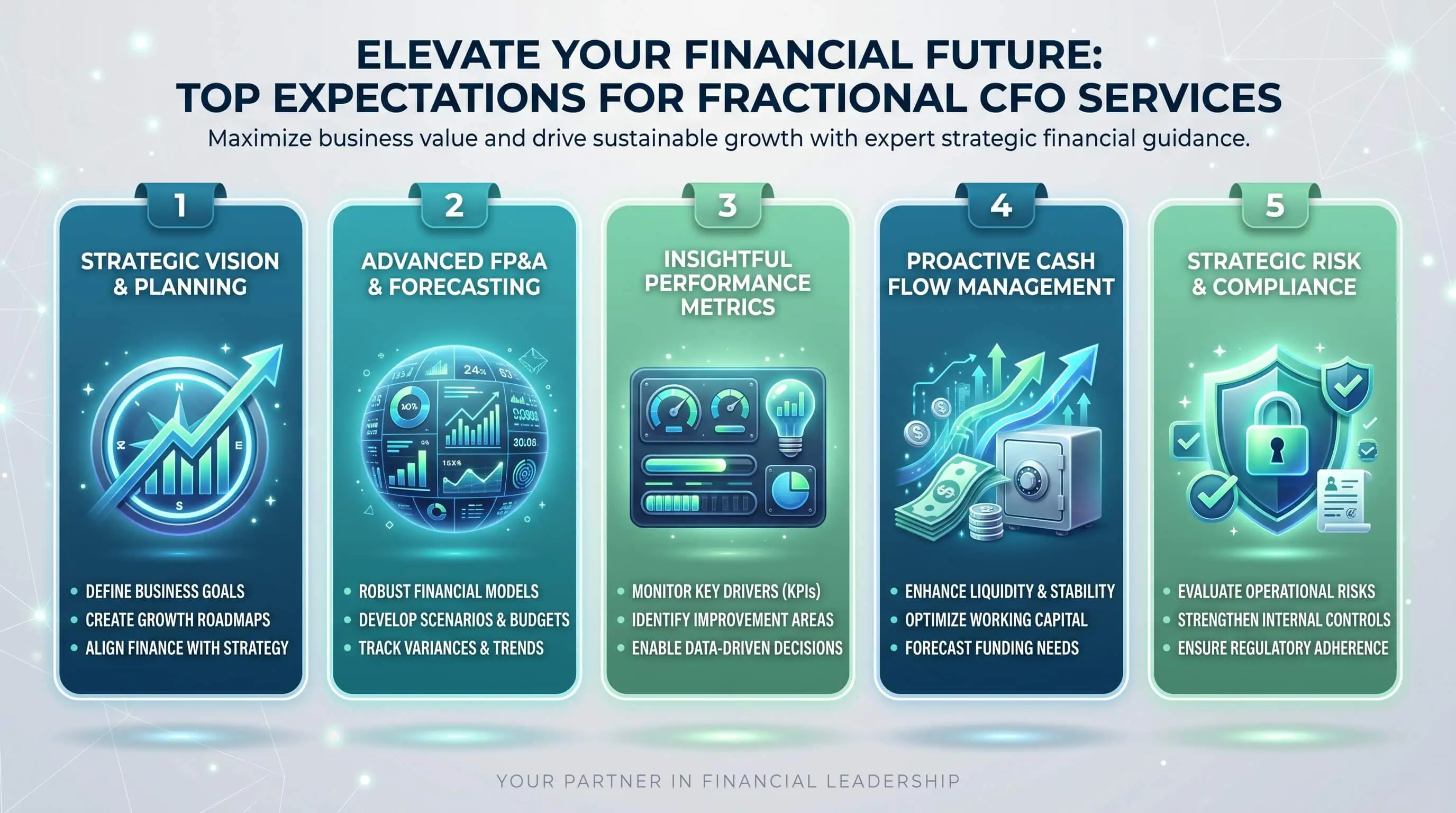
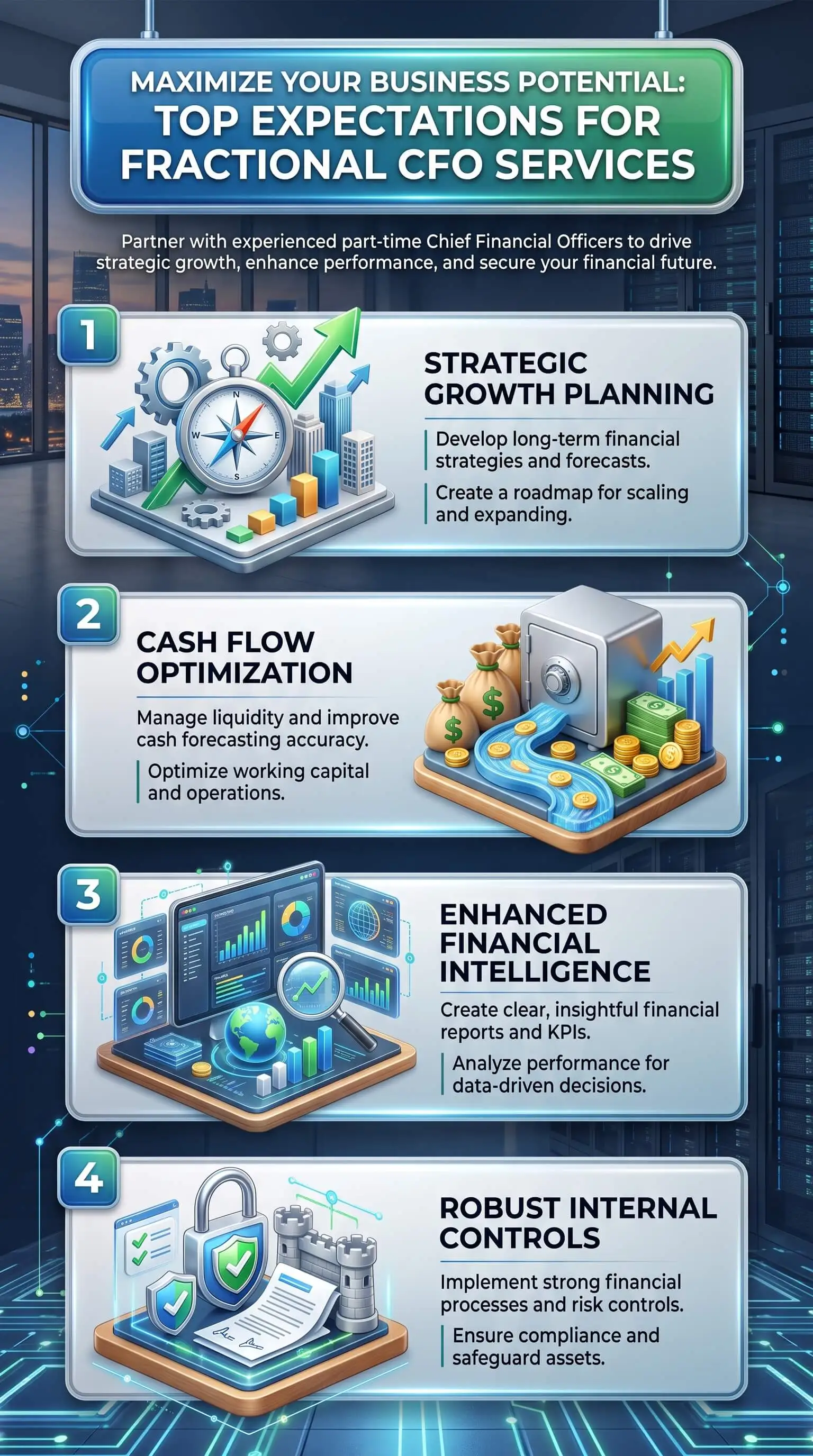
Fractional part-time CFO services should cover cash flow planning, budgeting and forecasting, margin insight, KPI tracking, and decision support. Nearly everything on that list looks forward, toward choices you haven't made yet.
A well-scoped engagement usually includes:
Cash flow modeling, with a 13-week forecast that shows timing gaps before payroll or rent comes due.
Rolling budgets and forecasts that change as the year does. A budget built in January is often out of date by spring.
Scenario analysis for big calls, like a new hire, a second location, or a price increase.
Costing and margin insight by product, service, or client, so you know which work pays for itself.
KPI dashboards built around the handful of numbers that move your business.
Payroll and growth modeling that prices out a new role before the job posting goes up.
Financial narratives that explain results in plain language for owners, boards, and lenders.
Systems guidance so your accounting, payroll, and billing tools feed one set of numbers.
A CFO guides the decisions, and a bookkeeper or controller keeps the books accurate underneath them, whether that support is in-house or provided by outsourced business and financial accounting firms. If your books are behind, fix that first, because every forecast depends on it.
What Should the Engagement Look Like Week to Week and Month to Month?
Expect a steady rhythm with something in writing at each step. If a provider can't tell you what arrives and when, the scope isn't finished.
First 30 days: A review of your books, cash, and reporting, a short list of agreed KPIs, and a 90-day plan aimed at your biggest gaps.
Weekly: An updated 13-week cash view, so you know whether payroll, bills, and planned spending are covered.
Monthly: Financial statements with budget-vs-actual comparisons, written notes on the variances, and a refreshed forecast.
Quarterly: A strategy review with updated scenarios and a pricing and margin check before you commit to a hire or an investment.
Annually: Next year's budget and financial plan, plus a look back at how this year's plan held up.
The weekly cash view pays off fastest in businesses with lumpy revenue. Marketing agencies are a good example. Retainers renew on different dates and project invoices get paid late, which is why creative services accounting for agencies puts so much weight on forecasting.
How Does a Virtual Fractional CFO Work With Your Team?
A virtual fractional CFO works from your shared systems and a set meeting schedule instead of a desk down the hall. For most small and midsize businesses that setup works well, and the CFO is often easier to reach than an in-house hire buried in meetings.
Day to day, it tends to look like this:
Read access to your accounting, payroll, and billing platforms
Cloud dashboards you can check any time, not only at month-end
Slack or email for quick questions between meetings
Video strategy reviews, followed by written notes and next steps
Distance rarely causes problems in this role, though slow replies and skipped reviews will.
What Separates the Best Fractional CFO Services From the Rest?
The strongest providers put specific, forward-looking deliverables in writing and explain them without jargon. Weaker ones sell open-ended "strategic support" and spend most of their hours reporting on the past.
Green flags
A written list of deliverables with a set schedule
Rolling forecasts and a 13-week cash view
Recommendations tied to your own numbers
Experience with businesses your size and in your industry
Pricing tied to a defined scope
Red flags
A scope that says "strategic guidance" and little else
Backward-looking reports with no cash forecast
Jargon that never turns into a recommendation
Open-ended hourly billing or fees that show up after the fact
Use the same test you'd apply when vetting any outside partner. Ask what you'll receive, how often it arrives, and how you'll both know it's working.
What Does a Part-Time CFO Cost Compared With a Full-Time Hire?
Most fractional CFOs charge a weekly or monthly retainer based on your size and complexity, and it runs well below a full-time salary. For reference, the Bureau of Labor Statistics puts the median wage for financial managers at $161,700 a year, before benefits, bonuses, or recruiting costs.
Retainers usually move with transaction volume, reporting needs, and how much strategy time you want each month. Compare proposals on what you'll receive rather than the rate alone. A low fee that still leaves you guessing about cash isn't saving you anything.
"In our experience, the owners who get the most from a fractional CFO ask the most specific questions up front. They want to know which forecast they'll get, how often it's updated, and who walks them through it. Once a business can see its next 13 weeks of cash and knows which clients are profitable, decisions get calmer. That clarity is the work we're there to do."
7 Essential Resources
Use these to benchmark costs, check the small business data behind this guide, and prepare questions for a provider.
BLS Occupational Outlook Handbook: Financial Managers. Official pay, duties, and outlook for full-time finance leaders, handy when you compare a hire with a retainer.
Federal Reserve Banks: 2026 Main Street Metrics. Nearly ten years of survey data on small business revenue, profitability, and financial challenges.
FRED: Small Business Financial Challenges, Employer Firms. A year-by-year chart of how many small employers report financial strain.
SBA: The Importance of Financial Literacy. Points owners to the SBA Business Guide and free courses on balance sheets, accounting methods, and financing.
SBA: Let the SBA Help You Better Understand Your Finances. Covers the SCORE mentors and Small Business Development Centers that offer low- or no-cost financial help.
Custom CPA: What Deliverables Should I Expect From a Fractional CFO? A practical list of monthly, quarterly, and annual CFO deliverables.
Burkland Associates: What to Expect From a Fractional CFO Service Package. Explains the 30-day baseline and 90-day plan that many engagements start with.
3 Statistics
These 2026 figures help explain why so many owners look for part-time financial leadership instead of a full-time hire.
$161,700 a year was the median annual wage for financial managers in May 2024, according to the Bureau of Labor Statistics. Add benefits and bonuses, and a full-time finance leader is out of reach for many small businesses.
94% of small employer firms reported at least one financial challenge in the prior 12 months, based on the latest Small Business Credit Survey data on FRED. With that many businesses under pressure, early warning on cash is worth having.
54% of firms with financial challenges used the owner's personal funds to get through them, according to the Federal Reserve Banks' 2026 Main Street Metrics. A dependable cash forecast gives owners time to plan for a shortfall before it reaches their own savings.
With full-time finance leadership costly and many small businesses facing financial pressure, remote outsourced QuickBooks bookkeeping services online can help keep financial records current and give part-time CFOs the reliable numbers they need to forecast cash, spot shortfalls early, and reduce the risk of owners having to rely on personal funds.
Final Thoughts and Opinion
In our view, the best fractional part-time CFO services show up as deliverables on your desk. A good engagement gives you a weekly read on cash, a monthly explanation of what moved, and a quarterly conversation about where the business is headed. If a proposal can't spell that out in writing, keep asking until it does.
Timing matters too. We've seen owners bring in help right after a cash crunch, when a 13-week forecast would have flagged the gap a month earlier. Starting a little before you feel the pressure almost always costs less than cleaning up after it.
Not every business needs a CFO yet, and that's worth saying plainly. If your books aren't current, or revenue is still modest and predictable, solid bookkeeping may be the better first step. Match the support to the decisions in front of you, and add CFO guidance once those decisions start outrunning your numbers.
Frequently Asked Questions
What does a fractional part-time CFO do?
A fractional part-time CFO gives you senior financial leadership without adding a full-time executive. The work usually covers cash flow forecasting, budgeting, scenario planning, margin analysis, and KPI reporting, along with regular strategy conversations. Most of it looks ahead, helping owners decide when to hire and how to price their work.
How many hours a month does a fractional CFO usually work?
It depends on your size and what's happening in the business. Some companies need a few hours a month for reporting and a strategy review. Others need a day or more each week during growth, a fundraise, or a systems overhaul. Good providers set the hours around the deliverables, not the other way around.
Is a virtual CFO as effective as an in-office CFO?
For most small and midsize businesses, yes. Accounting, payroll, and reporting tools run in the cloud now, so a virtual CFO sees the same numbers an in-house leader would. Responsiveness matters far more than location, along with a steady meeting schedule and written follow-up after each review.
What is the difference between a fractional CFO and a controller?
A controller makes sure the books are accurate, closed on time, and compliant. A fractional CFO takes those numbers and plans ahead with forecasts, scenarios, and advice. You'll get the most from both working together, since any strategy is only as reliable as the records it's built on.
When should a small business hire a fractional CFO?
Consider one when big decisions start outpacing what your numbers can tell you. Uneven cash flow, plans to hire or expand, pricing questions, and an upcoming conversation with a lender or investor are common signs. So is not knowing which clients or products actually make money, whether you run a service firm, a female owned marketing company, or another growing business. If your books are current, you're probably ready.
Get Clear on What Your Business Needs
Hold your current financial support up against the checklist above. If you can't see your next 13 weeks of cash or say which clients earn the most, virtual outsourced finance and accounting services can give you clearer visibility, and a short intro conversation with a fractional CFO is a sensible next step. No obligation, just clarity about where you stand.